
Fifty Years of the Piedmont Education Foundation: How a Community Came Together to Save Its Schools

From a small organization providing classroom enrichment in 1975 to a multimillion-dollar institution supporting teachers and educational programs, the Piedmont Education Foundation has played an extraordinary role in the history of Piedmont's public schools.
In January 1984, Piedmont made headlines across the Bay Area for an unusual reason. Its residents had raised so much money for their public schools that the School Board canceled a proposed election to increase school taxes.

The previous year, a door-to-door fundraising campaign organized by the Piedmont Education Foundation had raised approximately $500,000. The money helped protect teachers, programs, and educational services threatened by reductions in state funding. The achievement was remarkable, but it was not an isolated event. It was part of a growing movement in which Piedmont residents increasingly assumed responsibility for supplementing the funding of their public schools.
What began in 1975 as a small nonprofit organization providing classroom enrichment had become a financial lifeline for the school district. Over the following decades, the Piedmont Education Foundation (PEF) would help pass the city's first school parcel tax, establish a permanent endowment, support educational innovation, and raise millions of dollars for teachers and students.
Fifty years later, the foundation's history offers a revealing look at California school financing, the changing responsibilities of local communities, and the people whose volunteer efforts helped shape Piedmont's educational system.
At PEF's 50th anniversary celebration on November 5, 2025, Cameron Wolfe Jr., an early foundation president and one of the organizers of the first major fundraising campaigns, reflected on the work of the organization's founders and the generations of volunteers who followed them.
"The room tonight is full of heroes who have carried on our work," he told the gathering.
His remarks recalled a remarkable period when residents organized campaigns throughout the city, erected a giant thermometer near the Exedra to track donations, and raised hundreds of thousands of dollars to prevent educational programs from being eliminated.
The story of the Piedmont Education Foundation is also the story of a community that repeatedly confronted school funding crises and chose to organize rather than accept the loss of programs its residents valued.
Before the Foundation: Piedmont's Schools in the 1960s
Piedmont's tradition of supporting public education existed long before the creation of the Piedmont Education Foundation. Like school districts throughout California, Piedmont faced the continuing responsibilities of paying teachers, maintaining facilities, accommodating enrollment changes, and providing educational programs.
An April 17, 1962, article in the Oakland Tribune, titled "Teachers Win Pay Increase in Piedmont," provides an interesting glimpse into the district's financial operations thirteen years before the foundation was established.

The newspaper reported that the Piedmont Board of Education had approved salary increases totaling more than $29,000 for teachers during the following school year. The new salary schedule established annual pay ranging from $5,000 to $9,500. The board also approved an additional $9,858 in salary increases for classified employees. Substitute teachers would receive $20 per day for the first twenty days in the same position and $25 per day beginning on the twenty-first day.
The article documented another development in Piedmont's educational history: completion of a new junior high school addition and administrative offices. The School Board voted to move its regular meetings from Room 117 at Piedmont High School into the new board chambers in the junior high school addition, beginning May 7.
Although these events preceded PEF's founding, they provide a useful historical starting point. The costs of maintaining school facilities, compensating teachers, and expanding educational opportunities were longstanding responsibilities. What changed dramatically during the following two decades was the way California's public schools could raise and spend money. During the 1960s, school districts relied heavily on property taxes collected locally. Communities with more valuable property generally had greater financial resources available to their schools. Piedmont, with its valuable residential property and comparatively affluent population, benefited from that system.
But the resulting differences between wealthy and less affluent school districts would become the subject of an important legal battle that ultimately transformed California's public education system.
The Serrano Decision: A Changing System of School Financing
In 1968, John Serrano, a parent in the Los Angeles school system, initiated litigation challenging California's system of financing public schools. The lawsuit argued that relying heavily on local property taxes created unconstitutional inequalities in educational opportunities.
In 1971, the California Supreme Court issued an important decision in Serrano v. Priest, recognizing constitutional concerns about disparities in school funding based on local property wealth. Further litigation culminated in another major ruling during the 1970s, requiring California to reduce wealth-based differences in the funding available to school districts.
As Ann Chandler explained in her October 21, 2025, article for the Piedmont Exedra, affluent communities such as Piedmont understood that these changes could significantly affect the resources available to their schools. The full consequences were not immediately apparent. School districts faced uncertainty about how new state financing requirements would be implemented and how much local control they would retain. It was during this period of uncertainty that a group of Piedmont residents decided to establish an organization capable of providing additional resources for their public schools.
December 10, 1975: The Piedmont Educational Foundation Is Established
On December 10, 1975, twelve residents formally incorporated the Piedmont Educational Foundation.
According to PEF's published historical records, the original incorporators were:
Nancy Bates
Helen Breck
Helen Buttner
C. Lee Emerson
Albert F. Fliegner
Raymond D. Harper
William H. Knight, Superintendent of Schools
Irving Loube
Margaret McIvor
Walter F. Pettit
John R. Shuman
Ann Milton Wallis
The foundation was established to provide additional financial support and educational opportunities for the Piedmont Unified School District. Ann Chandler's historical account states that its original purpose was to provide "new and improved educational opportunities." The organization could receive tax-deductible contributions and make grants in response to proposals submitted by teachers and school district personnel. Importantly, the foundation was established three years before the passage of Proposition 13. Although that measure would eventually transform PEF's responsibilities, it was not the original reason for the organization's formation.
C. Lee Emerson: The Driving Force Behind the Foundation
At PEF's 50th anniversary celebration in November 2025, Cameron Wolfe Jr. recalled the organization's founding and the influential citizens who brought it into existence.
Wolfe described the original incorporators as a group representing prominent members of Piedmont's civic and professional community. He identified C. Lee Emerson as the individual most responsible for establishing the foundation. Emerson was a steel industry executive, associated with Gilmore Steel, and a longtime civic leader whose interests extended into education, health care, environmental preservation, and other charitable work.

According to Wolfe, the legal work necessary to establish the foundation was completed by the San Francisco law firm Pettit & Martin. Piedmont resident Walter Pettit was among the original incorporators. Wolfe emphasized that not all the founders were parents whose children attended Piedmont's public schools. Several did not send their children to Piedmont High School, and one did not send her children to any Piedmont school.
For Wolfe, this was an important indication of the founders' motivations. They were not simply attempting to provide advantages for their own children. They viewed strong public schools as an essential part of a successful community.
The foundation represented an investment in Piedmont's future.
The First Board Meeting
The foundation's first board meeting took place in February 1976 at C. Lee Emerson's home.
Emerson was elected the first president. Helen Breck subsequently became the second president, followed by Steffi Mooers as the third.
During the 2025 anniversary celebration, Wolfe recognized Breck as the youngest of the original incorporators and, at that time, the only surviving member of the founding group. Her presence at the anniversary celebration connected the foundation's beginnings in 1975 with the organization it had become fifty years later. In its earliest years, PEF operated on a relatively modest scale. Rather than underwriting the district's general operating budget, the foundation primarily awarded grants for projects intended to enrich the classroom experience. Wolfe recalled that teachers submitted proposals for relatively small amounts of money.
PEF's official history identifies early grants for a Teletype receiver and landscaping at the newly constructed Piedmont Middle School. These projects reflected a straightforward idea: private donations could provide educational opportunities beyond those available through public funding. The foundation's original role was supplementary.
Within a few years, however, California's school financing system would undergo another dramatic change.
Proposition 13: A Financial Crisis for California Schools
In June 1978, California voters approved Proposition 13. The initiative sharply restricted property taxes, limiting the general property tax rate to 1 percent of assessed value and restricting annual increases in assessed valuation. The measure also changed the distribution of property tax revenue and greatly increased the state's role in financing local schools. For California school districts, Proposition 13 compounded the financial changes already underway following the Serrano decisions.
Communities could no longer rely on their local property tax base in the same manner as before. In Piedmont, the effects became increasingly serious. The district faced reductions in revenue at a time when residents expected it to continue providing small classes, strong academic programs, music, arts, athletics, and specialized educational services.
By the early 1980s, the School Board was confronting difficult decisions about reducing staff and eliminating programs. Cameron Wolfe later recalled that city officials, including Emerson and other community leaders, encouraged the adoption of a municipal parcel tax as one way to replace lost local revenue. School officials, however, initially believed that a similar tax could not legally be imposed for the school district.
As financial difficulties mounted, the district increasingly turned to the Piedmont Educational Foundation. The organization created to enrich classrooms was about to assume responsibility for helping preserve basic educational programs.
1981: The First Major Fundraising Campaigns
Beginning in 1981, PEF organized ambitious fundraising campaigns to help offset the district's declining revenues. The foundation established a Steering Committee to direct the effort. Cameron Wolfe Jr. and Gerry Stahl became co-chairs. Rather than rely solely on a small number of large donors, the committee organized a broad community campaign involving parents, residents, and volunteers throughout Piedmont.
The fundraising effort was highly personal. Volunteers went door to door, explained the district's financial problems, encouraged neighbors to contribute, and coordinated donations and pledges. The goal was not merely to purchase supplemental classroom supplies. The district needed money to prevent existing programs and services from being eliminated. Wolfe recalled that the first large-scale campaigns were immediately successful, but that the district's needs continued to grow.
By 1982, Steffi Mooers had become the foundation's third president and was playing an important role in coordinating its fundraising activities. The campaigns required extensive cooperation among foundation volunteers, School Board members, administrators, teachers, and families. The Board identified proposed budget reductions, while PEF attempted to raise enough money to prevent them. This partnership developed into a distinctive model of community fundraising.
The School Board's "Buyback" List
One of the most important features of the campaigns was the creation of a prioritized list of educational programs that faced elimination.
The School Board held public hearings and determined which programs would be reduced or discontinued if additional funding could not be found. As contributions arrived, the district could restore programs from the list. The process became known as "buying back" threatened educational services.
A 1983 research paper by Judith S. Shoemaker, Emerging Role of Educational Foundations in Financing Education, described PEF's cooperative approach. Shoemaker identified three principal methods used by education foundations. Some foundations contributed money directly to districts and left spending decisions to elected school boards. Others awarded small grants to individual teachers.
Piedmont's foundation used a collaborative model in which the foundation and School Board worked together to establish funding priorities. This allowed PEF to direct its fundraising toward clearly identified needs while working with the district's public budgeting process. The model helped donors understand exactly what their contributions could accomplish.
The Giant Thermometer at the Exedra
Perhaps the most memorable symbol of the early fundraising campaigns was a giant thermometer erected near the Exedra at the entrance to Piedmont Park.
As money was raised, volunteers painted a red line higher on the thermometer to show progress toward the goal. Residents passing through the center of Piedmont could see how close the community was to restoring threatened school programs.
In his 2025 speech, Wolfe recalled:
"A gigantic thermometer was installed in front of the Exedra as the money came in."
The thermometer transformed the district's financial emergency into a highly visible community campaign. Each increase represented additional donations and the possibility of protecting another educational program.
Ann Chandler's 2025 historical account adds an important detail about the consequences for school employees. By law, school districts had to provide layoff notices by March 15 to certain employees who might not be retained for the following school year. This meant that the fundraising campaigns were operating against a real deadline. Teachers and other school employees faced uncertainty about their employment. As contributions arrived, the district could rescind notices and restore threatened positions or programs.
The fundraising thermometer therefore represented more than a financial target.
It symbolized the possibility of preserving jobs, maintaining programs, and reducing the disruption caused by the district's budget problems.
1982–1983: Extraordinary Fundraising Results
The amounts raised during the early campaigns were remarkable for a community of Piedmont's size.
A January 13, 1984, Oakland Tribune article reported that PEF had raised approximately:
$380,000 during the first major campaign
$420,000 during the second campaign
$500,000 in 1983
The article described an extensive door-to-door effort organized by volunteers. According to Helen Breck, more than 70 percent of parents had contributed, along with approximately 30 percent of residents without children in the schools. The newspaper estimated that between 45 and 50 percent of Piedmont households participated.
Donations ranged from $5 per month to $1,200 annually. Approximately 600 major donors contributed at least $500 each. These figures suggest a fundraising effort that reached well beyond a small circle of wealthy contributors. Residents without school-age children also participated, demonstrating that support for education extended across the community.
What Contemporary Researchers Found
A University of California, Berkeley study published in June 1983 provides additional information about the campaigns. The researchers reported that 38 percent of Piedmont households contributed during the 1982 campaign, which raised $420,000. For the 1983 campaign, the study reported approximately $512,000 raised, enough to restore all items on the district's proposed cutback list with approximately $38,000 remaining. The researchers estimated that the amount raised represented approximately 8 percent of the district's budget. They also reported an average contribution of approximately $400 and participation by 59 percent of families with children in the schools. These figures differ somewhat from the percentages later reported by the Oakland Tribune, which may reflect differences in the campaigns, reporting periods, or methods used to count donors.
Nevertheless, both accounts demonstrate the substantial reach of PEF's fundraising efforts.
Cameron Wolfe Remembers a Million-Dollar Crisis
Looking back at the early 1980s, Wolfe recalled the tremendous financial pressure on the district. By 1983, he remembered the district's needs reaching approximately $1 million. According to his account, the School Board asked Steffi Mooers and the foundation to help fill the gap. "At that point the Steering Committee kicked into high gear," he recalled.
The School Board developed its prioritized list of proposed cuts, and the fundraising committee intensified its efforts. Wolfe remembered the overall effort eventually exceeding $1 million and saving all the threatened programs. Contemporary reports identify a smaller amount for the specific 1983 campaign—approximately $500,000 to $512,000.
Wolfe's recollection may have included a broader fundraising period or a larger district financial need, but the surviving documents do not yet fully explain the difference.
The broader accomplishment is clear. Over several years, the foundation raised an extraordinary amount of money and enabled Piedmont's schools to preserve programs that might otherwise have disappeared. Piedmont's 1996 General Plan later credited the foundation with raising approximately $1.5 million between 1981 and 1985 to support the district's budget.
1982: Dress Best for Less Creates Another Way to Support Schools
During the same period, another important Piedmont institution emerged.
In 1982, community volunteers proposed creating an upscale resale shop where donated clothing and household goods could be sold to raise money for public education.
The idea became Dress Best for Less.
Unlike the annual Giving Campaign, the resale operation provided a way for residents to support the schools through donations of merchandise, volunteer work, and purchases. The organization developed into a longstanding partner of PEF.
Wolfe's 2025 anniversary speech specifically acknowledged Dress Best for Less and the involvement of Steffi Mooers in its early development. Over the following decades, the organization became a significant source of financial support for Piedmont's schools. The City of Piedmont's 1996 General Plan recorded that Dress Best for Less was operating in the Carriage House at the Recreation Center.
The organization eventually developed into an established resale business whose charitable contributions continued long after the financial crisis that helped inspire its creation. By October 2026, Dress Best for Less reported that it had contributed more than $1 million to Piedmont schools and neighboring communities over forty-four years.
That same month, it announced a $100,000 pledge to PEF's 2026 Giving Campaign.
Its longevity illustrates how the community's response to the school funding crisis created institutions that continued supporting education for generations.
1983: Piedmont's Fundraising Model Attracts Attention
By the early 1980s, education foundations were emerging throughout California.
Some were newly created organizations, while others, like PEF, had existed before Proposition 13 and were expanding their responsibilities. Piedmont's success attracted attention from researchers, educators, and residents in neighboring communities.
An interesting example appeared in the December 31, 1983, edition of The Berkeley Gazette. In a letter to the editor titled "Selective questionnaires," Berkeley resident Mrs. Robert Gregg criticized the Berkeley Education Foundation for distributing a questionnaire about educational funding priorities to only selected members of the community. Gregg argued that residents asked to contribute to the foundation should also have opportunities to influence how their donations were spent. To illustrate her concerns, she described a conversation earlier that summer with an unnamed woman whom she identified as a founder of the Piedmont Education Foundation.
According to Gregg, the woman had explained the importance of involving the entire community in determining what future contributions would purchase for the public schools. The letter does not identify the woman or establish precisely what procedures PEF used to gather community input. However, it demonstrates that Piedmont's foundation was already being discussed outside the city as an example of community fundraising. It also raises an issue that would become increasingly important as education foundations grew: who should determine how privately raised money for public education is spent?
Should decisions rest entirely with an elected School Board? With the nonprofit organization collecting donations? With parents? Or with the broader community?
Piedmont's collaborative fundraising model represented one approach to this question.
As foundations throughout California raised larger sums, questions about accountability, representation, and the allocation of donations became increasingly significant.
January 1984: A School Fundraising Drive Cancels a Tax Election
In January 1984, the extraordinary success of PEF's fundraising became headline news. On January 13, the Oakland Tribune published an article by Skye Dent and Tina Pania titled "Piedmont's school drive cancels tax."

The newspaper reported that the district's trustees had canceled a proposed tax increase election after community donations substantially reduced the immediate need for additional revenue.
Board member Ann Trutner expressed her delight at the outcome. Superintendent Robert French explained that the donations had significantly improved the district's financial position, leaving officials unable to identify a sufficiently serious need to justify the proposed tax increase at that moment.
The following day, the San Francisco Chronicle published a similar article under the headline "Piedmont Cancels Tax Vote." The Chronicle provided additional information about the district's financial circumstances. It reported that the foundation had raised approximately $500,000 the previous spring and that a one-time infusion of state aid had reduced the amount needed during the current school year. The $500,000 was being held over, and district officials believed that an additional $225,000 would be sufficient to address anticipated needs for the 1984–85 school year.
Together, the articles show how successful community fundraising had become.
PEF was raising enough money to influence decisions about the timing and necessity of local tax elections. But the cancellation also revealed a serious weakness in the system.
The school district could not assume that residents would continue contributing the same amounts every year. Fundraising depended on economic conditions, donor participation, and the willingness of volunteers to organize repeated campaigns.
A community might succeed in saving programs during one school year but face the same financial crisis twelve months later.
Piedmont needed a more dependable source of revenue. That realization would lead to one of the most important events in the foundation's history.
1984–1985: The Campaign for Piedmont's First School Parcel Tax
By late 1984, school officials had determined that a properly structured school parcel tax could legally be submitted to voters. According to Cameron Wolfe, the School Board decided on November 8, 1984, to proceed with a tax election. Once again, the board turned to PEF. Steffi Mooers, who was serving as foundation president, worked with the Steering Committee to organize a campaign.
The challenge was substantial. Under California law, the proposed tax required approval by at least two-thirds of voters. Wolfe recalled that Piedmont had previously rejected some school bond proposals, making the prospects for the tax uncertain.
He also explained that Mooers had investigated whether PEF could legally participate in an election campaign. After determining that such participation was permissible, she asked the Steering Committee to lead the effort. Wolfe remembered the campaign as one of the most remarkable accomplishments of his civic life.
Cameron Wolfe's Election Strategy
Wolfe brought an unusual resource to the campaign: his senior thesis from the University of California, Berkeley. The thesis examined how to conduct successful election campaigns in Alameda County.
He recalled:
"I dusted off my senior thesis at Cal, a study of how to conduct a winning election campaign in Alameda County."
According to Wolfe, a core group of approximately twelve volunteers organized the campaign. They obtained registered voter lists for all twelve Piedmont precincts.
Rather than rely entirely on newspaper advertisements or general appeals, they developed a highly organized effort to identify residents who supported the proposed tax. Wolfe and Mooers sent letters to Piedmont households asking residents to pledge their support.
The committee also used donor lists from earlier fundraising campaigns and conducted extensive telephone outreach. This allowed volunteers to identify likely supporters and encourage them to vote. Wolfe described the small group of organizers with pride:
"Basically, 12 of us pulled off what to this day I consider to be a miracle."
The strategy depended on organization, personal contact, and turnout.
On Election Day, volunteers worked to ensure that identified supporters reached the polls. Wolfe also recalled personally confronting an opponent whom he believed was improperly urging voters to reject the measure from inside a polling place.
The incident, as Wolfe remembered it, reflected the intensity of the campaign.
The Election Passes with 76 Percent Approval
The results exceeded the organizers' expectations. Piedmont voters approved the first school parcel tax in 1985 with approximately 76 percent voting in favor. The result comfortably exceeded the required two-thirds majority. According to Ann Chandler's 2025 account, every precinct in Piedmont surpassed the two-thirds threshold, with half of the precincts exceeding 80 percent approval. The victory marked a major turning point. For several years, voluntary fundraising had allowed Piedmont to preserve programs threatened by budget reductions. Now the community had established a more predictable source of local revenue. The foundation would continue fundraising, but the school district no longer had to rely exclusively on annual emergency campaigns to replace lost funding.
Remembering the Campaign Volunteers
During PEF's 50th anniversary celebration, Wolfe recognized several individuals who had participated in the early campaigns. Among those he named were Helen Breck, Steffi Mooers, Sue Smegal, and Ann Chandler. He also recalled that artist Grant Shaffer had created an illustration depicting the twelve members of the campaign committee at work. The illustration, along with other memorabilia from the period, represents an important part of the foundation's history.
For Wolfe, the volunteers deserved lasting recognition. He considered their work essential not only to the successful tax election but also to the preservation of Piedmont's schools during a difficult period. The passage of the 1985 parcel tax ended what Wolfe described as the foundation's early historical period. It did not, however, end the need for community fundraising.
Piedmont Becomes a Model for Other California Communities
The success of PEF's campaigns drew attention beyond Piedmont. On May 5, 1985, the Oakland Tribune published an article by Amanda Covarrubias titled "Parent groups take action to beef up budgets." The report examined the growing number of school foundations being established throughout California in response to Proposition 13 and the Serrano school finance decisions.

According to the article, the California Department of Education estimated that hundreds of education foundations had been established across the state. The report identified the Piedmont Education Foundation, the Marcus A. Foster Education Institute in Oakland, and the San Francisco Education Fund as established organizations frequently used as models by newer foundations.
The article also explained that different communities relied on different fundraising methods. Some foundations received substantial support from corporations and businesses. Others depended primarily on contributions from parents and community residents. Piedmont was particularly associated with direct fundraising from households and the participation of community volunteers.
In his 2025 anniversary speech, Wolfe recalled that PEF's early leaders actively assisted other communities. He stated that he, Helen Breck, and Steffi Mooers provided guidance to people establishing education foundations in Beverly Hills, San Marino, Contra Costa County, Marin County, and communities on the San Francisco Peninsula.
His recollection suggests that Piedmont's influence extended beyond its own school district.
PEF was not simply following a statewide trend. Its volunteers were helping other communities understand how to organize and operate similar foundations. Wolfe also recalled a school ranking published in 1987 in which Piedmont placed fifth among fifty California schools. According to his recollection, the four schools ranked above Piedmont were magnet schools with competitive admissions. Although the original survey has not yet been identified, Wolfe viewed the result as evidence that Piedmont's sustained investment in education had helped preserve a strong school system.
1987: Piedmont Residents Are Asked to "Return Your Rebate"
The passage of the first parcel tax did not end PEF's efforts to raise money. In October 1987, California taxpayers were preparing to receive rebate checks resulting from state revenues exceeding the Gann spending limit. The rebates ranged from approximately $32 to $236.
Several Bay Area school districts encouraged residents to donate their checks to public education. In Piedmont, PEF launched an ambitious campaign called "Return Your Rebate." An October 28, 1987, Oakland Tribune article reported that approximately 200 volunteers planned to contact households throughout Piedmont.
The goal was to persuade residents to redirect their state tax rebates to the foundation. The newspaper also documented some of the educational services supported by PEF at that time. These included elementary school instructional assistants, four high school classes, a middle school orchestra, and teacher training. The campaign again demonstrated PEF's ability to mobilize volunteers and find creative ways to raise additional money. Piedmont was not alone in pursuing the idea.
School districts and education foundations in Oakland, Berkeley, Alameda, Hayward, and other communities also organized campaigns encouraging residents to donate their rebates. Some school officials questioned whether the fundraising efforts might cause residents to underestimate the seriousness of continuing public education funding problems. Nevertheless, the rebate campaigns illustrated how local communities were searching for alternative sources of support.
1987–1991: New Programs and a Permanent Endowment
During the late 1980s, PEF began expanding its activities beyond emergency fundraising. In 1987, the foundation introduced an all-school Student Directory. The directory provided families with a convenient way to connect with one another and strengthened communication within the school community. Ann Chandler later became closely associated with the publication and its development.
Two years later, in 1989, PEF established an endowment fund intended to provide a permanent source of support for the district. The endowment represented an important change in financial strategy. Annual fundraising campaigns generally raised money to address current educational needs. An endowment, by contrast, could invest donated funds and provide recurring distributions to support future generations of students. PEF's leaders recognized that a permanent fund could help protect the schools against fluctuations in donations and public revenue. However, the financial problems of the early 1980s were far from resolved.
The 1991 Budget Crisis
In December 1991, the Oakland Tribune reported that Piedmont's school district faced a projected budget deficit of approximately $300,000.
District officials warned that they might have to reduce staffing or eliminate programs if additional financial support could not be found. Among the possibilities discussed were reductions in temporary teaching positions, sports coaching positions, and reassignment of existing staff. The School Board established a Revenue Enhancement Committee to investigate additional sources of income.
According to the newspaper, the committee's goal was to raise $5 million for an endowment capable of generating approximately $250,000 annually. PEF was expected to manage the proposed fund. The effort reflected an increasingly important concern: how could Piedmont create dependable financial support rather than repeatedly organizing emergency campaigns?
Superintendent Gail Uilkema also traveled to Sacramento as part of an effort to persuade state legislators to provide additional money for education. School officials argued that the state should provide sufficient funding for the programs and services it required districts to offer. This was a recurring tension in Piedmont's educational history.
Although the community repeatedly demonstrated its willingness to contribute additional money, school officials continued to maintain that responsibility for adequately financing public education rested with the state.
The Patron: Documenting What PEF Made Possible
In the fall of 1991, PEF published the first issue of The Patron, a publication intended to recognize donors and explain how foundation contributions supported the schools.
Ann Chandler was responsible for creating the publication.
The Patron provides an especially valuable historical record because it documents individual educational programs, grants, and projects that benefited from PEF funding.
The first issue addressed the challenges caused by declining enrollment. At the time, Piedmont High School had approximately 540 students, substantially fewer than the district expected to serve later in the decade. With fewer students enrolling in some courses, the district faced difficulties maintaining the breadth of its academic offerings.
PEF helped support low-enrollment electives, including foreign languages and music, so that students would continue to have access to these educational opportunities. The foundation also helped finance instructional aides at elementary schools when reductions in state funding threatened classroom support. These contributions illustrate the organization's importance beyond large fundraising totals. PEF was helping the district maintain programs that could otherwise have disappeared because there were too few students or insufficient state funding to support them. By preserving these programs, the foundation helped sustain the educational opportunities available to students during periods of financial uncertainty.
The 1996 General Plan Looks Back
Piedmont's 1996 General Plan provides a useful contemporary assessment of PEF's development. The city recorded school parcel tax measures in 1985, 1989, and 1993.
It also credited the foundation with raising approximately $1.5 million between 1981 and 1985 to underwrite the district's budget. By the mid-1990s, the General Plan characterized PEF's principal role as educational enrichment rather than simply maintaining existing programs. The distinction reflected a significant development.
Although the district continued facing financial challenges, the combination of parcel taxes and private fundraising had enabled the foundation to support innovative projects and educational improvements while also helping preserve established programs.
1990s–2000s: From Classroom Survival to Educational Innovation
During the 1990s, PEF continued supporting programs threatened by declining enrollment and state funding reductions. The foundation also began investing more heavily in educational technology. Its official history records contributions toward furnishing new and remodeled classrooms, developing a district technology plan, and funding a technology coordinator. These projects reflected changing expectations for public education. Computers, electronic learning tools, and new instructional materials were becoming increasingly important in classrooms. PEF helped provide resources that might otherwise have been difficult to finance through the district's regular budget.
1998: Electronics Kits for Science Students

A photograph from the 1998 PEF Patron, reproduced in Ann Chandler's 2025 historical article, shows Piedmont High School students working with electronics equipment purchased through foundation grants. The kits allowed students to assemble electronic circuits and investigate concepts involving logic gates, transistors, on-off controls, and related systems. They provided hands-on opportunities to experiment with principles used in a wide range of electronic devices. The project is an example of how PEF's classroom grants could directly expand educational opportunities. Rather than merely replacing supplies lost through budget reductions, the foundation helped teachers introduce new methods of instruction.
2005: Digital Projectors and Science Curriculum
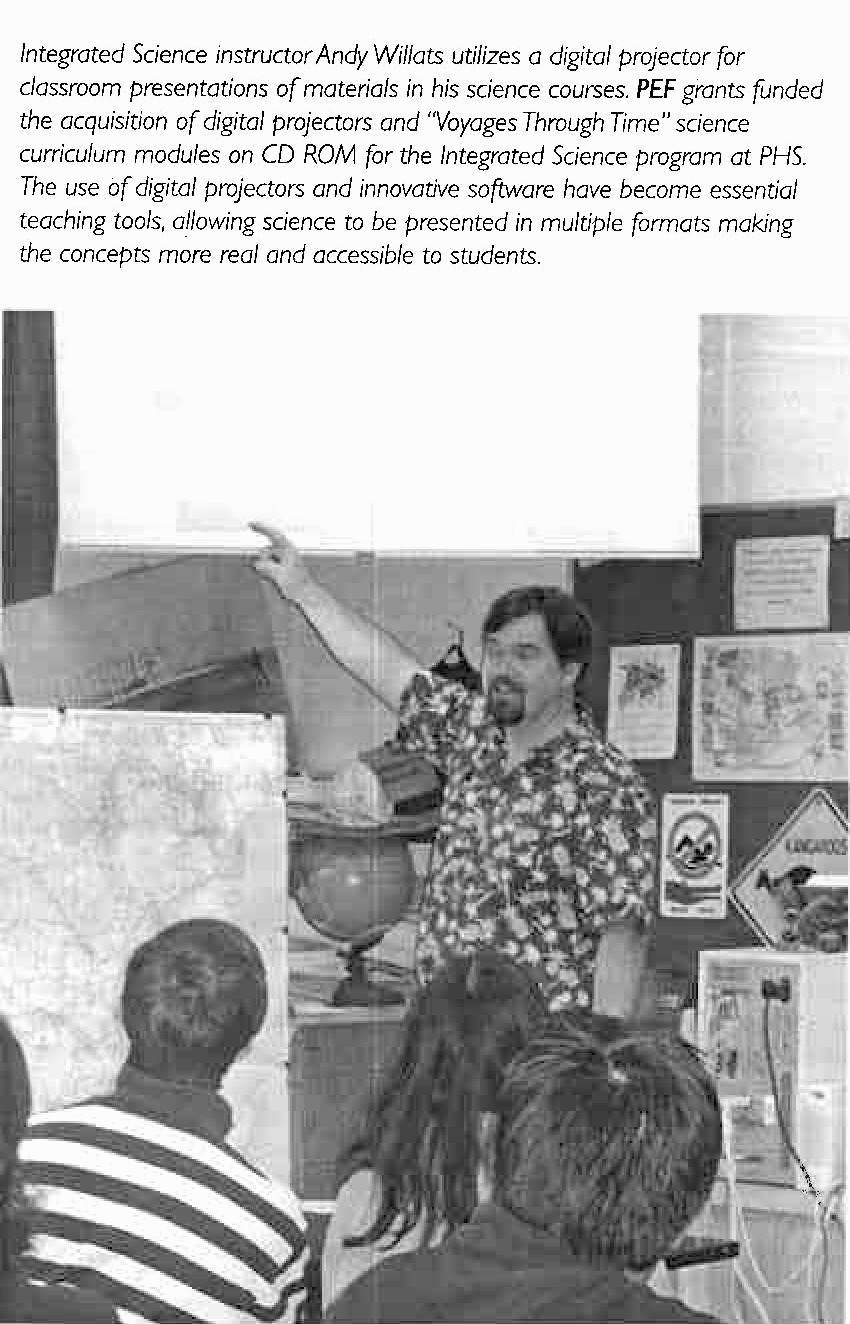
Another photograph, originally published in the 2005 PEF Patron, shows Piedmont High School science teacher Andy Willats using a digital projector in his classroom.
PEF grants helped purchase digital projectors and Voyages Through Time science curriculum modules on CD-ROM for the school's integrated science program. At a time when digital classroom technology was still developing, these tools allowed teachers to present material in new formats and make complex scientific concepts more accessible. PEF continued supporting essential educational programs while also making possible classroom innovations that enhanced teaching and learning.
The Amazing People Behind the Foundation
The history of PEF is not simply a record of fundraising totals. Its accomplishments depended on generations of volunteers who served as board members, campaign organizers, donors, school advocates, and community leaders.
C. Lee Emerson
C. Lee Emerson's involvement in PEF was part of a much broader record of public service. A June 27, 1990, Oakland Tribune article reported that Emerson would be honored by the Bay Area Tumor Institute through the creation of an endowment fund supporting cancer consultations. The article described his service to organizations including Peralta Hospital, the Boy Scouts, the Piedmont Education Foundation, and the League to Save Lake Tahoe. Emerson had also held senior positions in the steel industry and served on educational and scientific advisory boards. His work reflected a philosophy of civic participation that extended well beyond the schools.
Helen Breck
Helen Breck was one of the foundation's twelve original incorporators and served as its second president.
She was a prominent figure in the early fundraising campaigns and helped establish the foundation's community-based approach. At the 2025 anniversary celebration, Wolfe recognized her as the only surviving original incorporator. Her long association with PEF made her an important link between the organization's founding and its later development.

Steffi Mooers
Steffi Mooers served as PEF's third president and played a central role in the major fundraising campaigns of the early 1980s. Wolfe credited her with important leadership during the period when PEF expanded its responsibilities from classroom enrichment to preserving threatened school programs. She was also instrumental in the effort to pass the first school parcel tax. Her work helped transform a small grant-making organization into an influential community institution.

Cameron Wolfe Jr.
Cameron Wolfe Jr. helped organize the foundation's early large-scale fundraising campaigns as co-chair of the Steering Committee with Gerry Stahl.
He later became one of the principal organizers of the 1985 school parcel tax campaign. Wolfe's recollections offer a rare firsthand account of the strategies, personalities, and challenges involved in these efforts.

Ann Chandler
Ann Chandler served on PEF's Board of Directors from 1991 to 1999.
She was responsible for publicity for the original parcel tax campaigns and subsequently created The Patron and the PEF Student Directory. Her October 2025 article in the Piedmont Exedra provides another important firsthand perspective on the foundation's early history.
Sue Smegal
Sue Smegal was another longtime leader in Piedmont's school fundraising efforts.
In July 2005, the San Francisco Chronicle reported that Smegal, then president of the Piedmont Education Foundation, had been selected as grand marshal of Piedmont's Fourth of July parade. The honor recognized more than thirty years of service to the city's schools. Smegal's selection reflected the important place that school fundraising and civic volunteerism occupied in Piedmont's community life.
Grier Graff and Later School Leaders
Grier Graff, who later served on the Piedmont School Board, had previously been president of the Piedmont Education Foundation and the Beach Parents Organization.
A February 18, 2002, newspaper profile described his involvement in the 1997 school parcel tax campaign, school construction committees, and district strategic planning. His experience illustrates the close relationship between foundation leadership, parent organizations, and school governance.
Other residents, including longtime civic volunteer William "Bill" Drum, contributed to school bond campaigns, oversight committees, and broader community organizations.
Their stories reflect a tradition in which volunteers frequently moved between school fundraising, civic organizations, and municipal affairs.
The foundation's accomplishments were made possible not only by donations but also by the considerable time and organizational work contributed by these individuals.
2000–2015: A More Permanent and Professional Organization
As the twenty-first century began, PEF continued developing its financial and administrative systems. In 2000, foundation leaders undertook a campaign to expand the endowment and create a stronger permanent source of support for the district.
During the following years, PEF also invested in computer systems and software to manage donations and coordinate fundraising activities.
In 2005, it hired a fundraising coordinator to help track contributions and support campaigns organized by PEF, the Associated Parent Clubs of Piedmont (APCP), parent clubs, and other school support organizations. And by 2008, the foundation employed three part-time staff members. The organization was becoming increasingly sophisticated while continuing to rely heavily on volunteers.
2009: A Unified Giving Campaign
In 2009, PEF and APCP coordinated their fundraising efforts through a single fall Giving Campaign. This was an important step toward reducing duplication and organizing fundraising across the district. Rather than relying entirely on separate campaigns, the organizations sought to coordinate financial support for school programs, professional development, and educational innovation. The new approach reflected the growing complexity of fundraising. PEF was no longer simply organizing individual appeals for donations. It was helping coordinate fundraising across multiple schools and community organizations.
The 2010 School Budget Crisis
Despite the development of new fundraising systems, Piedmont's schools continued experiencing financial difficulties. On July 5, 2010, the Oakland Tribune reported that the district had approved a $28.7 million operating budget for the 2010–11 school year. The budget required substantial reductions in expenditures.
Projected expenses exceeded revenues by approximately $862,000, requiring the district to draw on its general fund reserves. The newspaper documented how important locally raised money had become to the district. The budget included approximately $8.1 million from the Measure B school parcel tax, $941,000 from the Measure E emergency parcel tax, $1.3 million from parent organizations, and $162,159 from PEF.
Even with these contributions, the district faced difficult financial decisions.
Teacher and classified employee furloughs helped reduce costs, while officials considered additional reductions in future years. A School Board member observed that the proportion of district revenue coming from donations had increased considerably over the preceding twenty-five years.
The article demonstrated that Piedmont's dependence on local financial support had not disappeared after the emergency fundraising campaigns of the early 1980s.
Instead, parcel taxes, parent fundraising, and foundation grants had become important components of the district's continuing financial structure.
2015: PEF and APCP Merge
In the spring of 2015, the Piedmont Education Foundation and the Associated Parent Clubs of Piedmont formally merged into a single organization. The merger was intended to increase efficiency in fundraising, administration, and the distribution of financial support. It also established clearer procedures for grant-making and reporting how contributions were used. PEF hired its first full-time executive director, reflecting the organization's increasing size and responsibilities.
The merger brought together the financial resources, administrative systems, and volunteer networks that had developed over several decades. The organization retained its community-based character but now had a more coordinated structure for supporting district-wide educational priorities.
2019–2024: Technology, Community Engagement, and Growing Grants
PEF continued developing its operations in subsequent years. In 2019, it established an online fundraising store to help school organizations and support groups manage donations and fundraising activities. During the COVID-19 pandemic, PEF moved many activities online, including fundraising events and programs recognizing students and families. It also supported a Healthy PUSD initiative intended to help the district address physical and mental health needs as schools reopened.
In 2022, PEF incorporated Piedmont Portal into its operations. Originally established in 2012 by community volunteers Holly Hanke, Mary Ireland, June Monach, and Andrea Swenson, Piedmont Portal provided families with school news and announcements. Its incorporation into PEF's communication system reflected the foundation's increasingly broad role in connecting the school community.
By 2024, PEF reported providing approximately $3.9 million in grant support to the district. The organization had become a substantial source of financial support for educational programs and personnel.
2025: Celebrating Fifty Years of the Piedmont Education Foundation
On November 5, 2025, current and former foundation leaders, school officials, city representatives, donors, and volunteers gathered to celebrate PEF's 50th anniversary.
The celebration was organized by the foundation's 50th Board of Directors, with Cameron Wolfe Jr. and Rich Thompson serving as co-chairs.
Thompson acted as master of ceremonies, while Wolfe shared stories of the organization's founding and the early fundraising campaigns. Among those recognized were Helen Breck, Steffi Mooers, Sue Smegal, Ann Chandler, and other individuals whose contributions helped build the foundation.
Wolfe's remarks emphasized that PEF's accomplishments extended beyond preserving school programs. He believed that the foundation had contributed to making Piedmont a more attractive place to live, strengthening civic participation, and encouraging generations of residents to become involved in public education. He also reflected on the foundation's influence outside Piedmont, recalling the assistance early leaders provided to other districts interested in establishing education foundations.

Honoring the Endowment's Supporters
During the anniversary celebration, PEF Board Chair Bridget Schreiber recognized the individuals who had sustained the organization over the years. She also announced Eileen Ruby as a new honorary board member. Ruby served on the PEF board from 1997 to 2003 and again from 2013 to 2023. She was recognized for her involvement in the development of the endowment fund, which had been established in 1989. By the anniversary year, the endowment was contributing approximately 10 percent of PEF's annual grant to the school district. The fund had become an important part of the foundation's long-term financial strategy.
Piedmont Education Foundation Day
The celebration concluded with a proclamation from Piedmont Mayor Betsy Smegal Andersen declaring December 10, 2025, Piedmont Education Foundation Day.
The date marked exactly fifty years since the organization had been incorporated.
The anniversary recognized not only the organization's financial achievements but also the generations of residents who had contributed to its success.
2025–2026: Record Grants to Piedmont's Schools
The foundation's 50th anniversary coincided with another period of substantial fundraising. In September 2025, PEF presented the Piedmont Unified School District with a grant of $4,116,427. At the time, it was the largest grant in the foundation's history.
The contribution represented a combination of Giving Campaign donations, fundraising events, business sponsorships, charitable partners, and an endowment distribution. In January 2026, PEF announced that its Giving Campaign had raised more than $4 million in gifts and pledges.
The foundation reported that campaign co-chairs Kim Hunter and Catie Osborn had helped raise more than $11 million for Piedmont schools over three years. The following September, PEF presented the district with another record grant. On September 9, 2026, the foundation announced a contribution of $4,355,000 for the 2026–27 school year.
According to PEF, the grant would support the equivalent of approximately 16 percent of teacher salaries, along with instructional aides, counselors, librarians, specialists, special education, professional development, health and wellness programs, and classroom supplies. The amount illustrated how dramatically the organization's financial responsibilities had expanded since 1975.
What began with small grants for educational equipment had become an institution providing millions of dollars annually to support the teachers and educational programs serving Piedmont's students.
The Continuing Importance of the Endowment
PEF's endowment has also become an important source of long-term funding.
The foundation reports that the fund has grown to more than $11 million, with annual distributions exceeding $400,000. Unlike annual Giving Campaign donations, endowment contributions are invested to produce recurring financial support.
This distinction reflects an idea that emerged during the early years of PEF's development: short-term fundraising could address immediate financial crises, but permanent financial resources were needed to provide stability. The endowment represents an attempt to balance those two responsibilities.
Cameron Wolfe's Reflections on the Foundation's Legacy
At the conclusion of his November 2025 anniversary speech, Cameron Wolfe returned to the idea that the foundation had changed more than the district's finances.
He believed that the early fundraising campaigns had helped shape the character of Piedmont.
The foundation had brought residents together, strengthened community participation, and encouraged families to view education as a shared civic responsibility.
Wolfe also recalled that the organizers of the early campaigns believed strong schools would contribute to the value and attractiveness of Piedmont as a place to live.
In his assessment, the foundation's work had helped establish a community strongly committed to public education and volunteerism. Such outcomes cannot be attributed to PEF alone, but his remarks reveal the broader ambitions of the organization's early leaders. For them, supporting the schools was not simply a matter of avoiding budget cuts.
It was an investment in the future of Piedmont.
Conclusion: A Lasting Investment in Piedmont's Schools
The Piedmont Educational Foundation began in December 1975 with twelve incorporators and a straightforward goal: provide additional educational opportunities for students in Piedmont's public schools. Within a few years, changes in California school financing transformed the organization's responsibilities.
The foundation moved from providing relatively small classroom grants to organizing citywide campaigns that raised hundreds of thousands of dollars to prevent the elimination of teachers and programs. Its volunteers established a fundraising thermometer near the Exedra, worked with the School Board to restore threatened services, and helped persuade voters to approve the city's first school parcel tax in 1985.
The foundation subsequently established an endowment, supported educational technology, preserved academic programs during periods of financial difficulty, and coordinated fundraising among Piedmont's schools.
Over time, it evolved into a professionally administered organization while retaining a tradition of volunteer leadership and community participation. By 2026, PEF was providing millions of dollars annually to support the district's teachers, staff, and educational programs.
It reflects the city's longstanding emphasis on public education, the challenges created by changes in state financing, and the efforts of generations of residents to preserve and improve their local schools.
The names of early leaders such as C. Lee Emerson, Helen Breck, Steffi Mooers, Cameron Wolfe Jr., Gerry Stahl, Ann Chandler, and Sue Smegal remain central to that history. So do the many other volunteers who contributed their time, organized campaigns, donated money, served on committees, supported fundraising events, and encouraged their neighbors to participate.
More than fifty years after the foundation's creation, its operations and financial responsibilities have changed substantially. But the original idea remains recognizable: investing in public education is an investment in the future of the entire community.
Historical Sources and References
Founding and Early History
Cameron Wolfe Jr. "Piedmont Education Foundation: 50th Anniversary," speech delivered November 5, 2025. Original four-page speech transcript supplied for this history.
Ann Chandler. "Supporting Excellence in Our Schools: The Founding of the Piedmont Education Foundation," Piedmont Exedra, October 21, 2025. Read the article.
Piedmont Education Foundation. Official Historical Timeline.
City of Piedmont. General Plan and Background Document, 1996, particularly the discussion of school financing and PEF in Section E-19.
Education Finance and Foundation Research
Judith S. Shoemaker. Emerging Role of Educational Foundations in Financing Education, November 1983. ERIC document ED242078.
Elliot A. Medrich and Victor Rubin. Services to Children and the Urban Fiscal Crisis: A Comparison of Experiences Among States and Localities, University of California, Berkeley, June 1983. Research report.
Historical Newspaper Articles
Oakland Tribune, April 17, 1962. "Teachers Win Pay Increase in Piedmont."
The Berkeley Gazette, December 31, 1983. "Selective questionnaires," letter by Mrs. Robert Gregg.
Oakland Tribune, January 13, 1984. "Piedmont's school drive cancels tax," by Skye Dent and Tina Pania.
San Francisco Chronicle, January 14, 1984. "Piedmont Cancels Tax Vote."
Oakland Tribune, May 5, 1985. "Parent groups take action to beef up budgets," by Amanda Covarrubias, including the continuation of the article.
Oakland Tribune, October 28, 1987. "Eastbay schools want your tax rebate," by Lynn Kidder.
Oakland Tribune, June 27, 1990. "Honors for outstanding citizen," concerning C. Lee Emerson.
Oakland Tribune, December 10, 1991. "Piedmont schools face budget deficit," by Glenn Chapman, including the continuation concerning the proposed endowment.
Oakland Tribune, March 21, 2000, and February 18, 2002. Historical coverage of school board candidates and school fundraising volunteers.
San Francisco Chronicle, July 5, 2005. Coverage of Piedmont's Fourth of July parade and Sue Smegal's recognition as grand marshal.
Oakland Tribune, July 5, 2010. "Piedmont school district OKs $28.7 million budget," by Linda Davis, including the continuation.
Oakland Tribune, January 15, 2013. "Drum was longtime civic volunteer," by Linda Davis.
Later History and Anniversary
Piedmont Education Foundation. Annual Reports and The Patron.
Piedmont Exedra, November 11, 2025. PEF Celebrates 50 Years of Supporting Excellence in Local Schools.
Piedmont Education Foundation, September 2026. PEF Presents Record $4.355 Million Grant.
Piedmont Education Foundation, October 2026. Dress Best for Less Grants $100,000 to Piedmont Schools.


Comments