
From Wildwood to the World: Saving the Station That Connected Piedmont to the World
Updated: Sep 8

The remarkable train station that connected the East Bay to the nation—and why it deserves another life
For more than a century, an enormous Beaux-Arts railroad station has stood at 16th and Wood Streets in West Oakland. Its three monumental arched windows, soaring waiting room, elevated platforms, and surviving signal tower hint at a time when thousands of people passed through this part of Oakland by train.
ChatGPT logos I made - feel free to use them.
Today, Oakland's 16th Street Station is silent.
Passenger trains no longer stop beside it. The tracks have been moved away, its grand interior has deteriorated, and the building has spent decades awaiting a restoration that has never fully materialized.
Yet this is far more than an abandoned railroad station. It was one of Northern California's great transportation gateways. It helped shape West Oakland. It welcomed generations of people migrating to California. It became closely associated with the Pullman porters and the Brotherhood of Sleeping Car Porters, whose labor organizing contributed to the modern civil rights movement. It later served as a setting for movies, music videos, performances, parties, and community events.
And perhaps surprisingly, it is part of Piedmont's history, too.
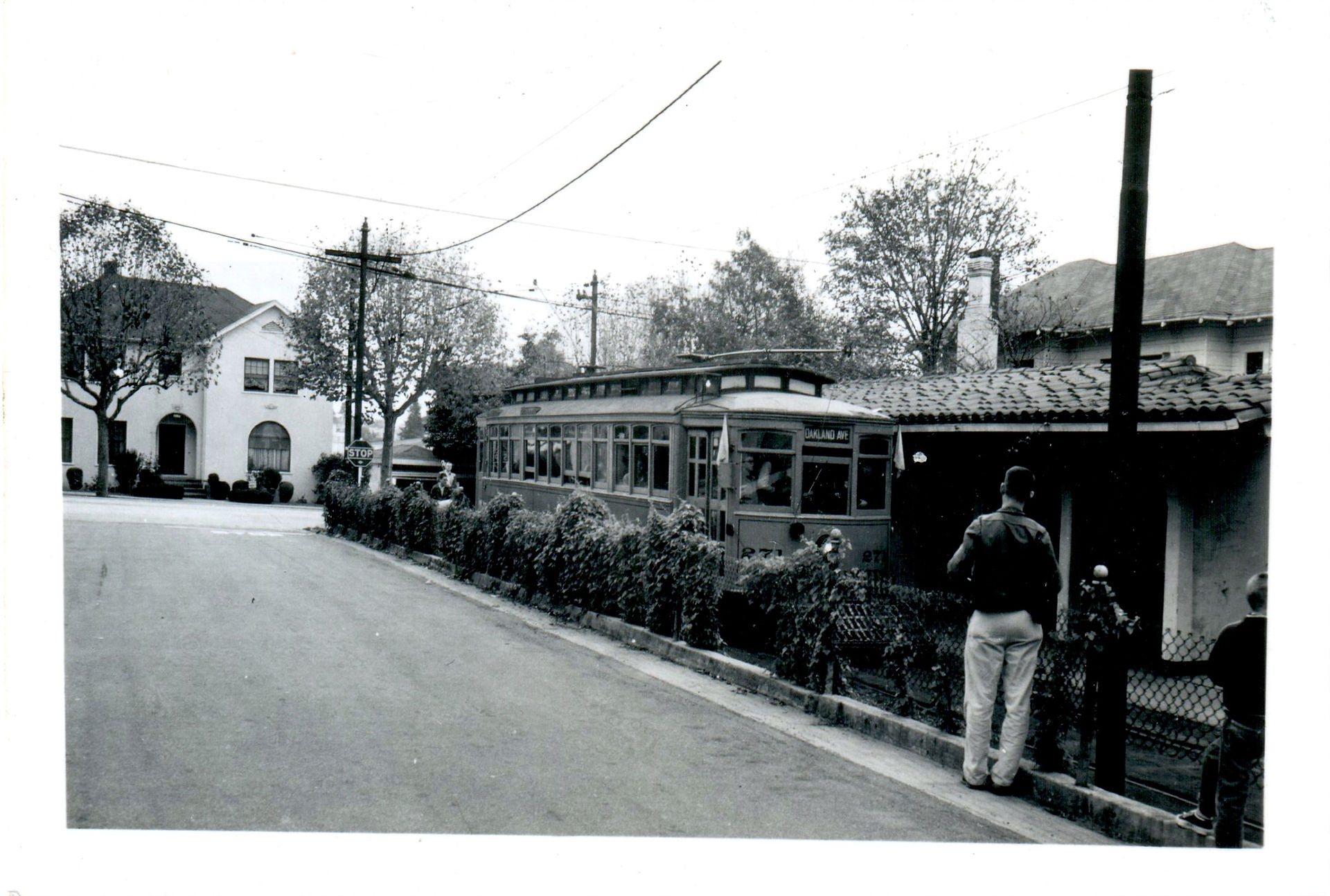
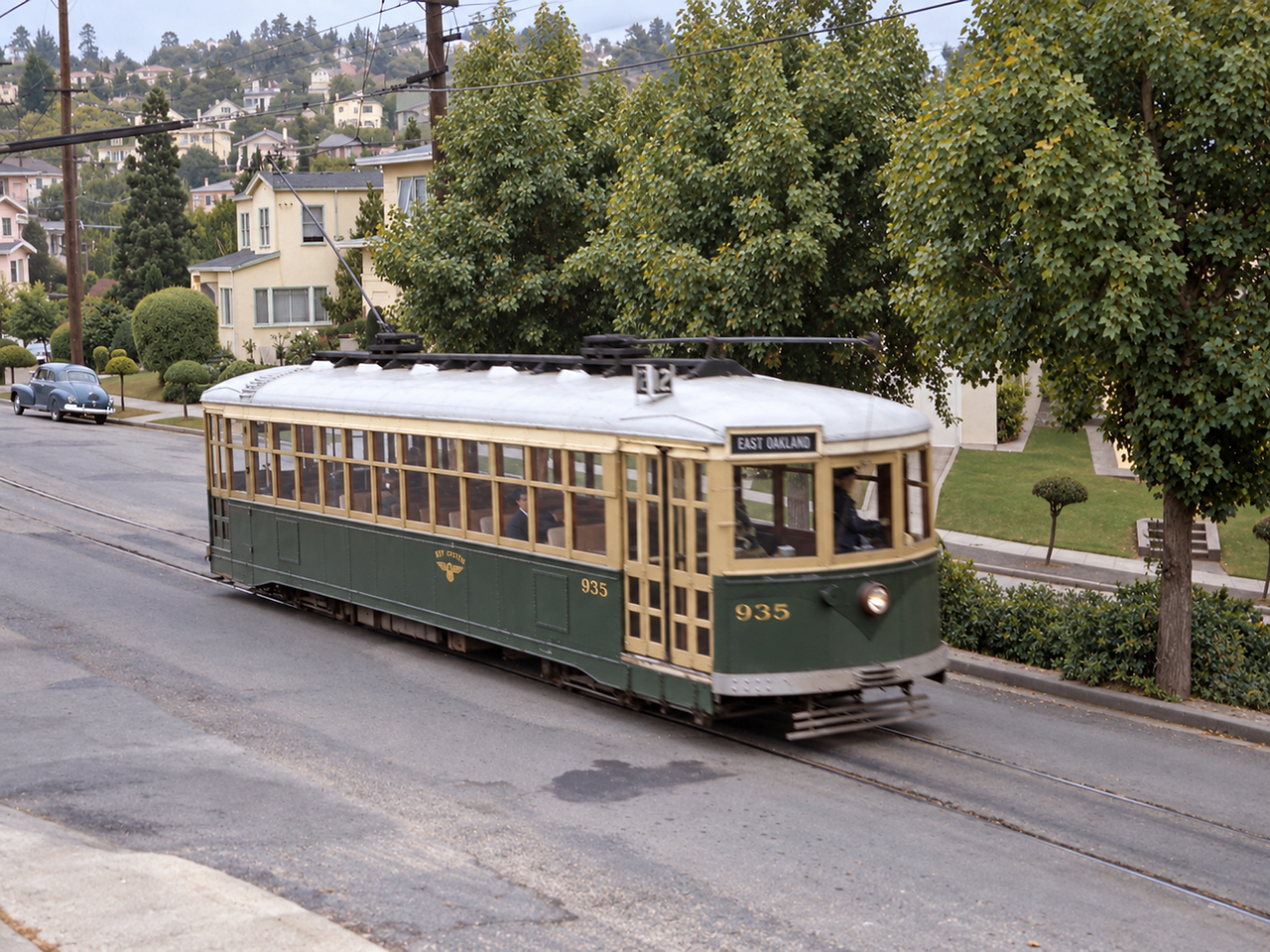
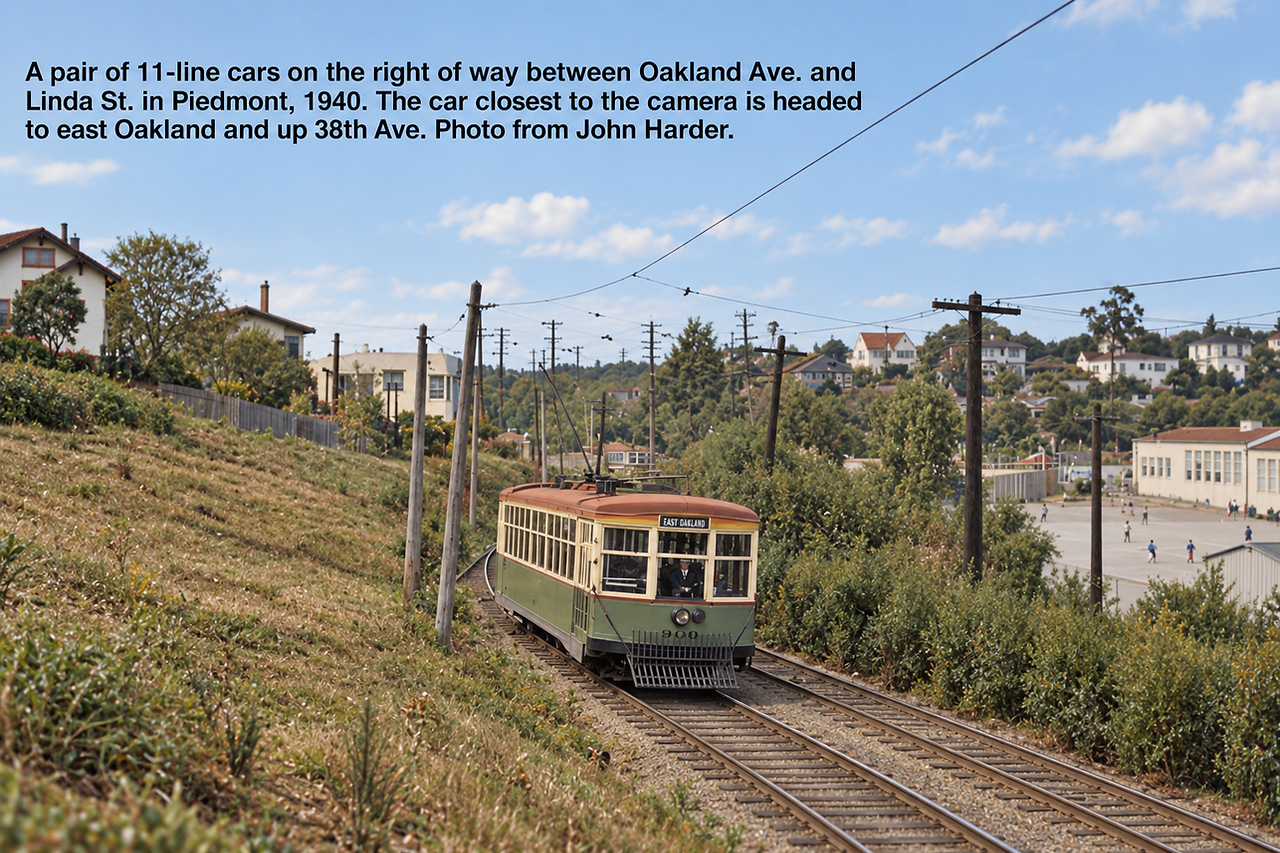
For a period beginning in 1912, a streetcar line originating at Wildwood Avenue at the Piedmont city limits traveled directly to Southern Pacific's 16th Street depot. From that station, Piedmonters could enter a transportation network capable of carrying them across California and, ultimately, across the country.
It was, quite literally, a route from Wildwood to the world.
Before the Grand Station
The railroad history of this site predates the building we see today.
An earlier wooden Southern Pacific depot stood near 16th Street when the shoreline of San Francisco Bay was considerably closer to the site. As Oakland expanded and portions of the shoreline were filled, the waterfront gradually moved westward. Local horsecar service reached the depot as early as 1880.

By the beginning of the twentieth century, Oakland had grown dramatically, and city leaders were envisioning a much more ambitious future.
Southern Pacific commissioned Chicago architect Jarvis Hunt, known for designing monumental railroad stations, to create a new Oakland depot. His design reflected the Beaux-Arts ideals popular during the City Beautiful movement: grand scale, symmetry, classical forms, and architecture intended to convey civic importance.

Construction culminated in the opening of the new station in 1912. The building's monumental character aligned with other ambitious civic projects underway in Oakland during the same era, including a new City Hall, Civic Auditorium, and Oakland Technical High School. The National Register documentation describes the station as an unusually successful example of Hunt's Beaux-Arts railroad architecture.
Inside, passengers entered a main hall measuring approximately 13,000 square feet, beneath a ceiling about 42 feet high. Three enormous arched windows filled the room with natural light. An adjoining baggage wing added another approximately 8,000 square feet. Behind the station stood elevated platforms for electric commuter trains and, nearby, the signal tower that controlled rail movements.
The result was not simply a train depot. It was a transportation complex.
Oakland's Gateway to the Country
During the height of American passenger rail travel, 16th Street Station functioned much like a major airport does today.
Southern Pacific trains connected Oakland with destinations throughout California and across the United States. At the same time, hundreds of local streetcars and interurban trains moved passengers through the East Bay.
Historian Mitchell Schwarzer told KQED that there could once have been 50 or more long-distance trains arriving each day, in addition to hundreds of local trains and streetcars. Some commuter trains used what KQED describes as among the first elevated railroad tracks constructed west of the Mississippi.
Before the Bay Bridge existed, reaching San Francisco required another step.
Passengers traveling through Oakland could continue toward railroad piers extending into San Francisco Bay and transfer to ferries for the final portion of their trip to San Francisco. After the Bay Bridge opened in 1936, rail service briefly operated across its lower deck as well. From 1936 until 1941, passengers could board electric trains at 16th Street and travel across the bridge toward San Francisco.
For visitors arriving from elsewhere in America, Oakland was often their first introduction to the Bay Area.
For people already living in the East Bay—including Piedmonters—the station offered the reverse: a gateway outward.
The Piedmont Connection
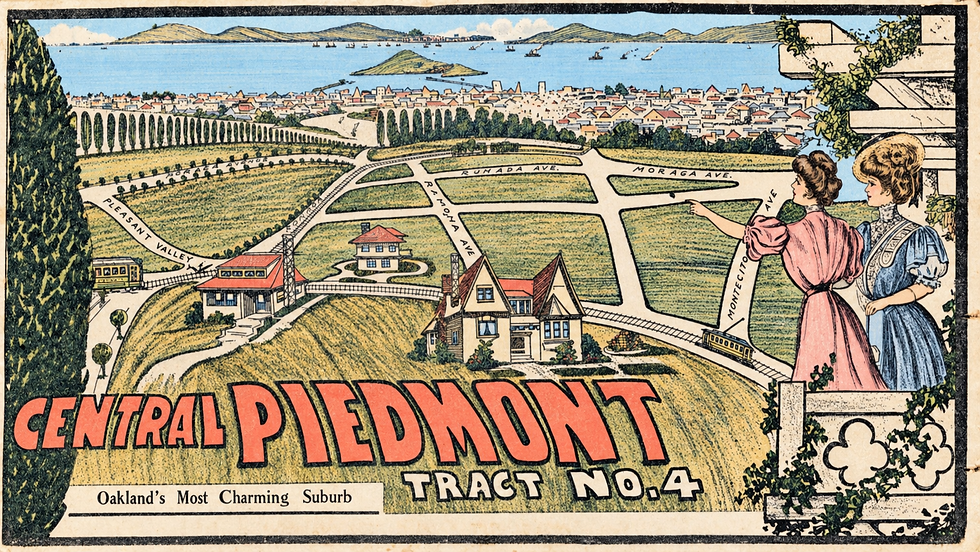
Piedmont's growth during the late nineteenth and early twentieth centuries was closely tied to streetcar transportation. Before automobiles became dominant, living in the hills above Oakland depended heavily upon rail and streetcar systems connecting residential neighborhoods with Oakland, San Francisco, employment centers, shopping districts, entertainment, and regional transportation.
One of those connections led directly to 16th Street Station.
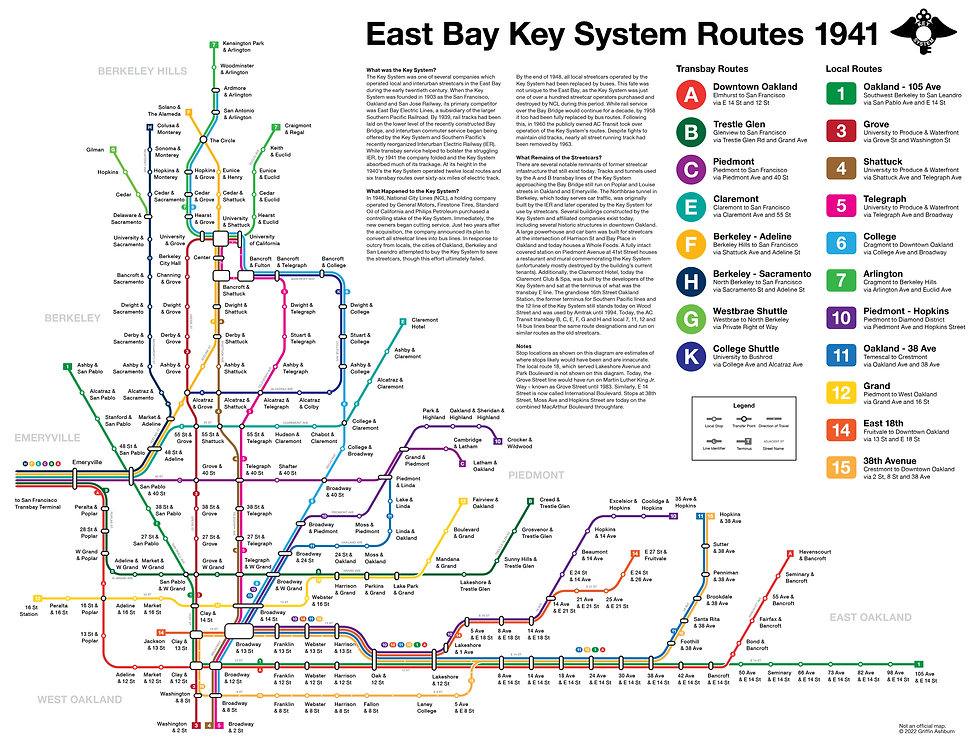
The Grand Avenue line originally operated as a shuttle from Wildwood Avenue at the Piedmont city limits to Perry Street, where riders could connect with the Lake Shore Avenue line.
Then, on December 26, 1912, only months after the new 16th Street Station opened, the former Grand Avenue shuttle was combined with the West 14th Street line.
Its new terminus was:
Southern Pacific's 16th Street depot.
That arrangement continued until February 1915, when the lines were reorganized and Grand Avenue service was instead connected with Key Route trains at Emeryville.
For those few years, the connection was wonderfully direct.
A passenger could begin near Wildwood Avenue in Piedmont, ride down into Oakland, arrive at the great Southern Pacific station, and from there connect with an enormous regional and national rail system.
Did Piedmonters actually use the station?
We currently have firm documentation that a transit route serving Piedmont connected directly with 16th Street Station. We do not yet have passenger records telling us exactly how many Piedmont residents traveled through the station or identifying all of them individually. So rather than claiming that 16th Street was the station for every Piedmont traveler, the evidence supports a more precise statement:
Oakland's 16th Street Station formed part of the regional transportation system available to Piedmont residents, and beginning in 1912, a streetcar line originating at Wildwood Avenue at the Piedmont city limits provided a direct connection to the Southern Pacific depot.
That alone makes the station an important part of Piedmont's transportation story.
But Piedmont's connection is only one small chapter in a much larger history.





A Station That Helped Build West Oakland
Railroads did not simply transport people through West Oakland. They helped create the community around the station. Southern Pacific was a major Oakland employer, drawing workers from across the country. For Black Americans leaving the Jim Crow South, railroad employment provided opportunities that were unavailable in many other industries. Many settled in West Oakland.
Restaurants, clubs, stores, churches, homes, and other businesses developed within the surrounding community. KQED describes the railroad, along with nearby military employment, as important foundations of a prosperous and culturally vibrant Black West Oakland.
For countless migrants, stepping off a train at 16th Street meant arriving at the beginning of a new life in California. And among the railroad workers who passed through the station were the men whose organizing would give the site significance far beyond transportation history.
The Pullman Porters and C. L. Dellums
The luxurious Pullman sleeping cars that carried passengers across the country relied heavily on Black porters. The jobs could offer opportunities unavailable elsewhere, but the conditions were extremely difficult. Porters endured long hours, low wages, discrimination, and an expectation of constant service to predominantly white passengers.
In 1925, Pullman porters began organizing the Brotherhood of Sleeping Car Porters under A. Philip Randolph. Oakland became one of the movement's most important centers. Oakland labor and civil-rights leader C. L. Dellums became a vice president of the Brotherhood and later its president. According to Oakland Heritage Alliance, the Oakland branch became one of the union's strongest and most persistent organizations.
The Brotherhood's significance extended far beyond railroad labor.
Its organizing helped secure greater economic stability for generations of Black railroad workers while developing networks and leadership that became important to the American civil-rights movement. In 1941, A. Philip Randolph and other leaders threatened a massive March on Washington to protest racial discrimination in defense employment—more than two decades before the famous 1963 March on Washington.
Oakland Heritage Alliance consequently describes 16th Street Station as a major center of Black labor organizing on the West Coast. This history is now formally recognized at the national level.
Decline, Freeways and a Changing West Oakland
By the middle of the twentieth century, the transportation landscape that had made the station so important was rapidly changing. Automobile ownership increased. Passenger rail declined. Streetcars disappeared. At the same time, West Oakland itself was transformed by enormous infrastructure projects.
During the 1950s and 1960s, freeway construction, urban renewal, the regional post office and later BART resulted in the demolition of homes and businesses and the displacement of thousands of residents, disproportionately affecting West Oakland's Black community. The station's surroundings changed profoundly.
By the late 1980s, only a handful of passenger trains stopped there each day.
Then came the 1989 Loma Prieta earthquake. The station was severely damaged and its historic building was condemned for passenger use. Train service temporarily continued using facilities adjacent to it, but gradually shifted elsewhere. The last Amtrak trains serving the 16th Street site stopped there in August 1994.
When Interstate 880 was reconstructed following the earthquake, the railroad tracks themselves were eventually moved farther west. The station that had once existed because of the railroad was now physically separated from it.
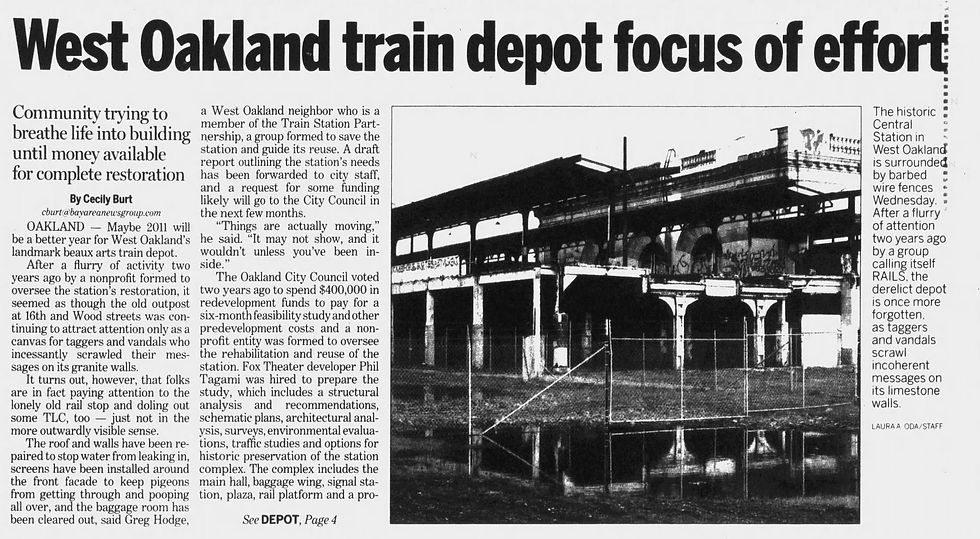

A Second Life on Film
Although trains disappeared, people found new reasons to enter the old station.
Its monumental architecture proved irresistible to filmmakers, photographers, musicians, artists and event organizers.
The station has appeared in films including Funny Lady, Chu Chu and the Philly Flash, Rent, and HBO's Hemingway & Gellhorn, for which portions of the interior were transformed into Madrid's Hotel Florida. Some of what visitors perceive today as the station's historic interior is actually movie scenery left behind. KQED noted that film productions installed architectural treatments and set pieces that remained inside afterward. Music videos filmed there have included Mumford & Sons' “Babel” and Oakland rapper E-40's “Tell Me When to Go.”
The building has also hosted opera, theater, weddings, artistic events, food events, raves, and Burning Man-inspired gatherings. These uses demonstrated something important:
People still want to be inside this building. The station may no longer work as a railroad depot, but that does not mean its useful life has ended.

Recognition at Last
Preservation advocates have been trying to save and reuse the station for decades.
A major breakthrough came on January 21, 2025, when the National Park Service officially added the Southern Pacific 16th Street Station and 16th Street Tower to the National Register of Historic Places.
Its listing is particularly meaningful because it was submitted under the National Register's African Americans in California, 1850–1974 historic context, formally acknowledging the station's relationship to Black history as well as its architectural and transportation significance.
Oakland Heritage Alliance had led the nomination effort and continues advocating for restoration and reuse of the station. National Register status does not guarantee preservation, repair falling plaster or provide a seismic retrofit. And it does not automatically give a historic building a sustainable future.

The Fight to Save 16th Street Station
The station remains vacant, and restoration will be complicated and expensive.
Its property was purchased by housing developer City Ventures in 2022. Current development plans include housing on the surrounding property, while preservation advocates have pushed for a plan that also rehabilitates the station itself. Oakland Heritage Alliance organized a 2024 design charrette specifically to explore how the proposed housing could coexist with meaningful restoration and reuse of the historic buildings.
The Alliance has suggested that restoration could happen in phases. A first phase could stabilize the building through seismic improvements, remediation, and exterior restoration. Later phases could restore the interior and create new uses. Their ideas demonstrate just how much potential remains here:
the enormous Main Hall could become an event or exhibition space; the Baggage Wing could support small businesses, artists, offices, or community uses; the elevated platform could become an unusual indoor-outdoor public space; and the signal tower could interpret the site's railroad history.
The possibilities are far broader than creating a static museum.
Above are suggestions using ChatGPT for colorization and creativity.
Why Piedmont Should Care
It might be tempting to think of the 16th Street Station as solely a West Oakland story.
It is unquestionably a West Oakland landmark, and its Black labor and civil-rights history must remain central to any interpretation of the site. But historic places often tell overlapping stories. For migrants arriving from the South or Midwest, this station represented the beginning of a new life in California.
For Pullman porters, it was a workplace.
For C. L. Dellums and labor organizers, it was connected to a struggle for economic and racial justice.
For Oakland businesses and residents, it was an economic engine.
For travelers, it was a gateway to San Francisco.
And for residents of communities such as Piedmont, it was one piece of the network that connected their homes to the rest of the country.
The fact that a streetcar could once begin at Wildwood Avenue in Piedmont and terminate at this station makes that shared history wonderfully tangible. Piedmont did not develop in isolation. Its growth depended upon Oakland's streetcars, railroads, businesses, workers, ports and transportation infrastructure. Looking at places like 16th Street Station helps restore those connections to our understanding of local history.
Imagine What This Place Could Become
Imagine walking through those enormous doors again.
Imagine the windows restored and sunlight filling the Main Hall.
Imagine an exhibit explaining how someone standing at Wildwood Avenue in Piedmont could once travel by streetcar to this station.
Nearby, another exhibit could tell the far more consequential story of the Pullman porters, C. L. Dellums and Black labor organizing.
Historic photographs could show the migrants who arrived here.
Maps could trace Southern Pacific routes across America.
An elevated platform could become public space.
The baggage rooms could house artists, local organizations or businesses.
Schoolchildren could come here to learn how transportation shaped Oakland—and how communities organized for change.
Concerts, lectures, weddings, performances, exhibits and community celebrations could once again fill a building designed to accommodate crowds.
Preserving historic buildings does not require freezing them in time.
It means understanding what makes them important and finding ways for them to remain part of our communities.

A Station Built to Connect People Should Connect Us Again
Oakland's 16th Street Station has already survived more than a century.
It survived the decline of Southern Pacific passenger service.
It survived the destruction and displacement that reshaped West Oakland.
It survived the Loma Prieta earthquake.
It survived decades without trains.
And after years of advocacy, it has finally received national recognition for its architectural, transportation, African American, labor and civil-rights significance.
But recognition alone is not preservation.
There is still a remarkable building standing at 16th and Wood Streets—and there is still time to decide what happens to it. For those of us in Piedmont, supporting its preservation is also an opportunity to recognize something broader about our own history. Our communities have always been more connected than the lines on a city map suggest.
More than a century ago, one of those connections ran from Wildwood Avenue to 16th Street Station. From there, the rails continued almost anywhere. Perhaps it is time to restore that connection—not by bringing the trains back, but by helping bring the station back to life.
A building that once connected Oakland, Piedmont and the nation deserves the chance to connect people again.
Timeline: Oakland's 16th Street Station
Year | What Happened |
1880 | Horsecar service was extended to the earlier Southern Pacific depot at 16th Street. |
1912 | The new Beaux-Arts 16th Street Station, designed by Jarvis Hunt, opened. |
Dec. 26, 1912 | The Grand Avenue streetcar shuttle beginning at Wildwood Avenue at the Piedmont city limits was combined with the West 14th Street line and terminated at Southern Pacific's 16th Street depot. |
1914 | The station complex expanded with its signal tower and elevated facilities for electric interurban trains. |
1915 | The Grand Avenue route was reorganized, ending its direct 16th Street Station connection. |
1925 | Pullman porters organized the Brotherhood of Sleeping Car Porters; Oakland later became one of its most important centers under C. L. Dellums. |
1936 | The San Francisco-Oakland Bay Bridge opened, including rail tracks on its lower deck. |
1936–1941 | Electric trains serving 16th Street could travel across the Bay Bridge toward San Francisco. |
1941 | The Brotherhood threatened a March on Washington over employment discrimination, helping pressure the federal government to act against discriminatory defense-industry hiring. |
1950s–60s | Freeway construction, urban renewal and other infrastructure projects dramatically altered West Oakland, while automobile use and declining rail ridership weakened the station's role. |
1971 | Amtrak took over most American intercity passenger rail service and continued using 16th Street as its major Oakland station. |
1984 | The Southern Pacific station was designated an Oakland landmark. |
1989 | The Loma Prieta earthquake severely damaged the station and ended passenger use of its main building. |
1993–94 | Train service was progressively shifted to Emeryville. |
Aug. 21, 1994 | The final Amtrak service at the 16th Street site ended. |
2005 | BRIDGE Housing's affiliate acquired the station property with hopes for redevelopment and reuse. |
2010s | The station continued appearing in movies, music videos, performances, weddings and major events. |
2022 | BRIDGE sold the property to City Ventures. |
2024 | Oakland Heritage Alliance organized a preservation campaign and design charrette to explore restoration and reuse alongside proposed housing development. |
Jan. 21, 2025 | The Southern Pacific 16th Street Station and 16th Street Tower were officially listed on the National Register of Historic Places. |
2025–26 | Oakland Heritage Alliance continued advocating for stabilization, restoration and adaptive reuse. |

Support Oakland History
Saving places like the 16th Street Station is only one part of preserving Oakland’s history. Just as important is protecting the photographs, maps, newspapers, documents, oral histories, and other records that allow us to understand the people and communities connected to these places.
The Oakland History Center Friends (OHCF) supports the Oakland Public Library’s Oakland History Center through financial assistance, volunteer and technical support, community outreach, and efforts to locate and preserve historic materials for the collection. The Oakland Public Library has maintained an archival history collection for more than a century, and the Oakland History Center has been part of the Main Library since 1951.
Recent Friends projects have included funding digitization, inventorying archival collections, cataloging historic Oakland tract maps, identifying East Bay landmarks in vintage aerial photographs, and helping with public history programs. Their work helps ensure that Oakland’s history remains available not only to researchers and historians, but to everyone who wants to better understand the city and its past.
Sources and Further Reading
Oakland Heritage Alliance. 16th Street Station. History of the building, the Brotherhood of Sleeping Car Porters, preservation campaign, proposed adaptive-reuse ideas, photographs and additional resources. Oakland Heritage Alliance: 16th Street Station
Oakland Heritage Alliance. Oakland's 16th Street Station Officially Listed on National Register of Historic Places. January 2025. Read the National Register announcement
National Park Service. National Register of Historic Places Weekly List, January 24, 2025. Official documentation confirming the January 21, 2025 listing. National Park Service listing
Brunzell Historical / Oakland Heritage Alliance. National Register of Historic Places Registration Form: Southern Pacific 16th Street Station and 16th Street Tower. An especially valuable detailed source on the station's architecture and historical significance. Read the National Register nomination
Dahlstrom-Eckman, Azul. KQED Bay Curious. How Oakland's 16th Street Train Station Helped Build West Oakland and the Modern Civil Rights Movement. Updated March 2025. An excellent overview of the station, West Oakland, railroad workers, migration, the Pullman porters and C. L. Dellums. Read the KQED story
Dahlstrom-Eckman, Azul. KQED. Historic Landmark Status Boosts Push to Restore Iconic West Oakland Train Station. January 31, 2025. Read KQED's preservation update
History of Piedmont. Key System. Includes the history of the Grand Avenue line between Wildwood Avenue at the Piedmont city limits and the Southern Pacific 16th Street depot, citing Vernon J. Sappers' Key System Streetcars: Transit, Real Estate and the Growth of the East Bay. History of Piedmont: Key System
California Preservation Foundation. Oakland's 16th Street Station: The Depot that Fueled a Population Boom. Program featuring Oakland historian and former Oakland History Center librarian Dorothy Lazard. California Preservation Foundation
Oakland Heritage Alliance. 16th Street Station Charrette. Documentation of the 2024 effort to explore housing development together with preservation and reuse of the station. 16th Street Station Charrette
Help Keep 16th Street Station Standing
Oakland's 16th Street Station has survived for more than a century, but its future is not guaranteed. Oakland Heritage Alliance and other preservation advocates are working to ensure that new development around the site includes meaningful restoration and reuse of the historic station and signal tower.
Learn more about the history, follow preservation updates, sign the preservation campaign, or support Oakland Heritage Alliance's work

This isn't only about saving an old building. It is about preserving the place where stories of transportation, migration, Black history, labor, civil rights, Oakland—and even Piedmont—intersect.
Note: ChatGPT was used to help with colorizing the pictures and write up.


Comments