
When Piedmont Sounded the Alarm: Air-Raid Sirens, Wartime Blackouts, and Civil Defense, 1941–2026
Updated: 5 hours ago

From darkened streets and neighborhood air-raid wardens during World War II to a network of six warning sirens during the Cold War, Piedmont spent decades preparing for attacks that never came. More than 80 years later, one of the original sirens still survives.

On August 28, 1950, a familiar but long-silent sound suddenly returned to Piedmont.
City officials had reconnected the old World War II air-raid siren mounted atop City Hall. The equipment had been disconnected since the war ended five years earlier, and officials wanted to find out whether it still worked.
It did.
For approximately 35 seconds, the siren's piercing wail echoed across Piedmont, startling residents and triggering a flood of telephone calls to City Hall and Oakland newspapers. Callers wanted to know what was happening and whether the city was facing an actual emergency. Officials reassured them that it was only a test.
The following day's Oakland Tribune reported that the siren had survived its years of inactivity and remained in working condition. The incident marked the beginning of a new chapter in Piedmont's civil defense history. Within six months, the city would expand from one siren to six, strategically distributed throughout its neighborhoods.
The warning system became part of daily life during the Cold War, when the threat of nuclear attack transformed the way American communities prepared for disasters.
But the story actually began years earlier, when wartime fears prompted Piedmont residents to darken their homes, restrict automobile headlights, organize neighborhood volunteers, and prepare for possible attacks from the Pacific.
And in November 2026, research into this forgotten system revealed something unexpected: one of Piedmont's original air-raid sirens is still on the roof of the firehouse and can still be manually activated.
Preparing for War Before Pearl Harbor
Piedmont began organizing its civilian defense efforts before the United States officially entered World War II. On August 21, 1941, the City Council adopted Ordinance No. 97, establishing a local Defense Council and outlining its responsibilities.
The timing is significant. The United States would not enter the war until after Japan attacked Pearl Harbor on December 7, 1941. Nevertheless, mounting international tensions had already prompted American cities to begin preparations for possible attacks.
Four days after Pearl Harbor, on December 11, the United States was at war with Germany and Italy as well as Japan. Local governments faced the possibility that the conflict might extend to the West Coast. Piedmont's next civil defense ordinance, No. 99, had been adopted on December 10, 1941. It authorized designated officials to issue emergency orders intended to protect public safety.
The city continued expanding its preparations through the first months of 1942. Residents were encouraged to learn first aid, organize neighborhood defense groups, prepare their homes for blackouts, and understand the warning signals that would announce an approaching attack.
On April 9, 1942, the City Council adopted its most comprehensive wartime emergency legislation: Ordinance No. 102 (New Series), the Blackout–Air Raid Alarm Ordinance. This document survives as an original printed notice headed Piedmont Civilian Defense, followed by the instructions "Important — Please Read."
The ordinance defined the city's warning signals, established blackout requirements, created the office of Director of Civilian Defense, granted enforcement authority to designated officials, and prescribed penalties for violations.
It was introduced and passed at a special City Council meeting. Councilmembers Dinsmore, Wood, Bonner, and Council President Lawrence F. Moore voted in favor. Councilmember Fairchild was absent. The document was signed by Moore and City Clerk Weare C. Little.

It provides an unusually detailed picture of the responsibilities imposed on Piedmont residents during wartime.
SECTION 12.
Any person who shall operate a siren, whistle or other audible device in such a manner as to simulate an air raid warning signal or an all clear signal, except upon order of the said Chief of Police, Director of Civilian Defense or other proper authority, shall be guilty of a misdemeanor.
What Happened When the Air-Raid Siren Sounded?
Under Piedmont's April 1942 ordinance, the air-raid warning signal would consist of a two-minute fluctuating or warbling sound, or a succession of intermittent blasts lasting approximately five seconds each, separated by three-second pauses.
The all-clear was different: a continuous, steady two-minute sound.
The distinction mattered. Residents needed to recognize whether an alert meant an attack was possible or whether the danger had passed. The ordinance placed authority over the signals with Piedmont's Police Chief, who could order them sounded after the district received instructions through the United States Aircraft Warning Service. Once an alarm began after dark, strict rules took effect.
Lights out, immediately
Residents were prohibited from allowing lights to remain visible outside their homes unless they were inside properly enclosed blackout structures. The ordinance generally required household lighting to be extinguished within one minute. A responsible adult could maintain lighting within an enclosed structure only if no light escaped outdoors.
The same requirements affected businesses and other occupied buildings. The goal was to make the city difficult to identify from the air.
Drivers had to stop
Motorists were required to pull as far as practicable to the side of the road, clear of intersections, fire hydrants, hospitals, and other important locations. Drivers then had to extinguish their lights and remain stopped for the duration of the nighttime alarm unless directed otherwise by an authorized official. Certain emergency vehicles were exempt, including military vehicles, authorized police and fire vehicles, and designated civil defense personnel responding to an emergency.
Air-raid wardens could enforce the rules
The ordinance gave peace officers, firefighters, and certified air-raid wardens considerable authority to enforce blackout requirements. Under Section 8, an official could enter premises, using reasonable force when necessary, to extinguish unauthorized lighting.
Residents also could not simply disregard a warden's lawful instructions. Section 14 established penalties of up to $300 in fines, three months in county jail, or both for violations. This was not simply a voluntary community preparedness program. Piedmont's blackout system was backed by enforceable municipal law.

Air-Raid Wardens and Neighborhood Volunteers

The sirens were only the most audible part of Piedmont's civil defense organization.
The city's preparedness efforts relied heavily on volunteers who received training in communications, first aid, neighborhood patrols, firefighting, and other emergency responsibilities. An especially revealing artifact survives in the form of civilian defense identification cards issued to Clayton David Russell of 224 El Cerrito Avenue. One card records his appointment as a messenger in the Piedmont Citizens Defense Corps on April 29, 1942. Another documents his enrollment in countywide civilian defense training.
The cards bear the familiar triangular Civil Defense emblem and demonstrate how local residents were incorporated into an organized emergency response network.
Piedmont's wartime preparations were extensive enough that residents had specific identification credentials and official duties. Other volunteers trained to assist with feeding and caring for people displaced or injured during a disaster.
Piedmont Boy Scouts Help Prepare the City for Air Raids
In the weeks immediately following the Japanese attack on Pearl Harbor, Piedmont's Boy Scouts took on an important role in the city's civilian defense efforts. According to a December 21, 1941, Oakland Tribune article, Piedmont's Citizens' Defense Committee called upon local Boy Scouts twice during the preceding week to assist with emergency community service.

One particularly urgent assignment involved distributing circulars to households throughout Piedmont explaining the precautions residents should take in the event of an air raid. The Scouts mobilized quickly, and the newspaper reported that they had contacted every home in Piedmont within just two hours.
The same newspaper reported that Piedmont Scouts were receiving instruction in first aid, signaling, mapping, and compass skills at the Piedmont Community Church. These activities helped prepare young volunteers to assist their community during an emergency.
An accompanying photograph on the newspaper page illustrated the broader East Bay scouting community's involvement in civilian defense. It showed Bill Silver, the newly appointed director of Camp Dimond, and Scout Bert Saunders of Troop 51 participating in first-aid training. The caption explained that hundreds of Senior Scouts, Scoutmasters, and committee members were expected to receive training through the Oakland Chapter of the American Red Cross. Scouting volunteers were also assigned to communications work.
These accounts demonstrate that Piedmont's wartime defense preparations depended on more than sirens, police officers, and official ordinances. Young volunteers helped distribute essential information, ensuring that residents knew how to respond if an air-raid warning sounded.

One newspaper report describes 13 young women who completed American Red Cross canteen training under Roxana Elliott, a home economics instructor at Piedmont High School.
The students studied nutrition and mass feeding and practiced preparing food for large groups. Their role was to reinforce Piedmont's Disaster Relief Center No. 10, where volunteers would provide assistance if an emergency overwhelmed the city's normal services. Together, these programs reveal the human infrastructure behind the sirens. Warnings could summon emergency workers, but a successful response depended on trained residents throughout the community.
When Piedmont Went Dark: The Wartime Dim-Outs

The possibility of enemy aircraft was only one concern during World War II. Military officials also feared Japanese submarines operating off the California coast. In February 1942, a Japanese submarine shelled the Ellwood Oil Field near Santa Barbara, reinforcing concerns about attacks on West Coast installations. Military authorities believed that the glow of coastal cities could help enemy vessels identify shorelines, harbors, industrial facilities, and potential targets. Consequently, communities throughout the Bay Area were required to reduce nighttime lighting.
These restrictions were commonly called dim-outs.
A dim-out differed from a full air-raid blackout. A blackout was an emergency measure intended to extinguish visible lighting when a warning sounded. A dim-out imposed continuing restrictions on ordinary lighting, particularly lights that might be visible from the sea.
The difference was important for residents. A person might legally drive along a main road with limited headlights during a dim-out, but would be required to stop and turn off those lights during an actual nighttime air-raid alarm.
September 16, 1942: Several major roads were exempted
On September 16, 1942, newspapers reported that six major East Bay thoroughfares had been opened to motorists using full headlights. These included MacArthur Boulevard, Grand Avenue, Piedmont Avenue, Santa Clara Avenue, Park Boulevard, and Trestle Glen Road. The Alameda County Council of Defense also revised the boundaries of the automobile dim-out zones.

The published descriptions identify five areas, described as "islands," that were excluded from the restricted automobile lighting territory. Some of these areas involved streets in and around Piedmont, including Linda, Lake, Greenbank, Wildwood, Warfield, and other residential roads. The detailed descriptions are fascinating because they effectively created a street-by-street geography of wartime regulations. Residents could encounter different rules within a relatively short drive, depending on their location.
These exemptions applied to the automobile dim-out restrictions. They did not eliminate the obligation to obey a full blackout during an air-raid emergency.
The unexpected danger of darkened streets

By October 1942, authorities were reporting a troubling consequence of reduced nighttime lighting. According to figures released by the Berkeley Police Department, approximately 37% of the city's motor vehicle accidents during a 54-day period beginning August 20 had been attributed to dim-out conditions. The report identified 27 injury accidents associated with the restricted lighting, resulting in 41 injuries and eight deaths. These were Berkeley statistics, not Piedmont's. Nevertheless, they illustrate the dangers that Bay Area communities were confronting.
Safety officials urged motorists to reduce speed, maintain their vehicles, keep windshields clean, and avoid excessive use of headlights. Pedestrians were advised to wear light-colored clothing or carry a white object to make themselves more visible.
Newspaper reports also show that officials continued clarifying restrictions on automobile parking lights.
One clarification prohibited leaving lights illuminated on parked cars when those lights were visible from the sea, although exceptions could apply to brief stops.
The restrictions demonstrate how wartime precautions altered ordinary activities. Driving home after dark required residents to think not only about traffic laws but also about military defense regulations.
The regional dim-outs were gradually relaxed during 1943. San Francisco ended its dim-out restrictions on November 1 of that year, although the exact local termination date for Piedmont remains to be established.
The Other Side of Wartime Fear
Piedmont's civil defense preparations also reveal a more troubling aspect of wartime life: how fear of enemy attack influenced attitudes toward civil liberties.

On February 19, 1942, Police Chief William V. Pflaum wrote to California Attorney General Earl Warren in response to questions about potential sabotage and the treatment of people classified as enemy aliens. His letter survives in the Earl Warren Papers at UC Berkeley. Pflaum wrote that the immediate danger within Piedmont itself was relatively slight, given the city's residential character. Nevertheless, he believed the statewide danger was serious and called for immediate action.
He supported removing enemy aliens from combat zones and additionally recommended removing all Japanese people regardless of where they were born.
That recommendation included American citizens of Japanese ancestry and reflected the discriminatory wartime assumptions that helped justify mass exclusion and incarceration. The correspondence is significant because it establishes that Piedmont's Police Chief participated directly in statewide discussions about wartime restrictions.
Warren was California's attorney general at the time. He would become governor in January 1943.

Another newspaper report describes Leo Ostaggi of 11 Cavanaugh Court, a Piedmont resident whose name appeared on a local air-raid warden roster. Ostaggi was subsequently ordered by military authorities to leave the West Coast after being classified as potentially dangerous to military security. The newspaper documents the exclusion order but does not independently establish that Ostaggi had committed wrongdoing.
These records remind us that the wartime emergency extended beyond sirens and blackouts. It also produced decisions that profoundly affected the rights and lives of individuals and families.
Piedmont's World War I Memorial and Governor Earl Warren's 1943 Visit
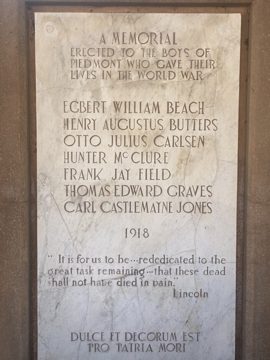
While residents were living under wartime restrictions, Piedmont continued commemorating the sacrifices of an earlier generation. On November 11, 1921, the city had dedicated a memorial to seven Piedmont servicemen who died during World War I.
Designed by architect Albert Farr, the original memorial stood along Highland Avenue near the former entrance to Piedmont Park. It featured a semicircular seating arrangement, steps, and a marble tablet protected by a tile roof.
The memorial honored:
Egbert William Beach
Henry Augustus Butters
Otto Julius Carlsen
Hunter McClure
Frank Jay Field
Thomas Edward Graves
and Carl Castlemayne Jones.
The project was organized through the Piedmont Post of the American Legion, with fundraising assistance from the Women's Guild of the Piedmont Interdenominational Church. Major General George Barnett delivered the dedicatory address, and Eleanor Graves, sister of Thomas Graves, unveiled the memorial. The site became an important location for Memorial Day and Armistice Day observances.
November 11, 1943: Earl Warren visits Piedmont




During World War II, Governor Earl Warren participated in Piedmont's Armistice Day commemorations. Photographs preserved in the Earl Warren Papers record the November 11, 1943 observance, including Warren's appearance with military officers and the placement of a wreath at the memorial. The original handwritten descriptions on the backs of the photographs establish the date and subject of the event.
These images are a valuable connection between the community's remembrance of World War I and its continuing involvement in World War II. They show that even as residents prepared for possible attacks on the Pacific Coast, the city maintained ceremonies honoring those who had served and died in earlier conflicts. The original memorial tablet now stands near Piedmont's Veterans Memorial Building, having been relocated from its earlier setting.

The Exedra, built several years after the original World War I memorial, would also become an important wartime gathering place. During World War II, large service honor-roll signs were displayed at the Blue Vase, recording the names of Piedmont residents serving in the armed forces and those who had died. On June 3, 1945, a large World War II service honor roll was dedicated at the Exedra. The names of approximately 1,000 Piedmonters were recorded, including Carl Smith. The signs formed a visible reminder of how extensively the community had been affected by the conflict.

Decades after World War II, the original wooden service-roll boards were rediscovered beneath the Oakland Avenue bridge. An April 25, 2016 article in The Piedmont Highlander reported that Katie Korotzer and Terisa Whitted, had recovered the historic sign bearing 990 names. The discovery helped form the foundation of the Piedmont Wall of Honor project, which documented the military service of residents and Piedmont High School graduates. The new Wall of Honor eventually opened at the Piedmont High School library in September 2018.

Additional reading:
1950: The Air-Raid Siren Returns

When World War II ended, the air-raid siren atop Piedmont City Hall was disconnected. For several years, the warning system was no longer needed. That changed with the arrival of the Cold War.
The Soviet Union tested its first atomic bomb in August 1949. Fighting began in Korea in June 1950, and the possibility of a new international conflict brought renewed attention to civil defense across the United States. American cities began reconsidering their emergency communications networks, including sirens left over from World War II.
In Piedmont, officials decided to reconnect and test the old City Hall siren. The August 1950 trial showed that the equipment remained operational, but subsequent testing revealed a serious limitation.
One siren could not reliably warn the entire city.
Piedmont's hills and irregular street pattern created areas where the sound was difficult to hear. Officials began planning an expanded network intended to reach every neighborhood.
January 1951: Piedmont Purchases Five More Sirens

On January 12, 1951, the Oakland Tribune reported that the Piedmont City Council had authorized the purchase of five additional sirens. Police Chief William V. Pflaum explained that the equipment would be placed at strategic locations throughout the city to eliminate the areas residents could not hear during earlier tests. The newspaper estimated that the five new sirens would cost approximately $1,350, including installation.
Officials hoped to mount the equipment on Pacific Gas and Electric Company power poles if permission could be obtained. Otherwise, the city planned to erect its own supports. The new sirens were to be controlled from City Hall and activated in conjunction with the existing rooftop siren. The January 12 report identified five proposed locations, but subsequent articles reveal that some of the positions changed before installation.
Where Piedmont's six sirens were installed

On February 6, 1951, the Oakland Tribune published the locations of the completed six-siren system:
Location | Description |
Piedmont City Hall | Original rooftop siren |
Wildwood and Winsor avenues | New siren |
Greenbank and Lake avenues | New siren |
Moraga Road and Highland Avenue | New siren |
Bell and Blair avenues | New siren |
Indian Road and Hampton Road | New siren |

The City Hall siren was described as a 7½-horsepower unit, while the five additional sirens were described in the February article as 2½-horsepower units. There is an interesting discrepancy in the earlier reporting. The January 12 article described the proposed units as two-horsepower sirens and identified Grand and Oakland avenues and Hampton Avenue and Estates Drive as two of the proposed locations.
By February 6, those locations had been replaced by Greenbank and Lake avenues and Indian and Hampton roads. The surviving records therefore document both the original plan and the later reported installations. The reason for the changes, and whether the sirens ultimately used PG&E poles or city-owned structures, remains unknown.
February 9, 1951: Six Sirens Sound Across Piedmont

At precisely 7 p.m. on Friday, February 9, Piedmont's six air-raid sirens sounded simultaneously. Each produced a steady blast lasting one minute. Police officers were stationed at strategic locations throughout the city to determine whether any neighborhoods remained beyond the range of the warning system. The test was considered a success.

The following day's Oakland Tribune reported that officers had found no areas where the sirens could not be heard. The sound also traveled far beyond Piedmont's boundaries. City Hall received approximately 30 telephone calls from residents in East Oakland, North Oakland, the Lakeshore area, and Montclair who had heard the warnings.
The calls demonstrated the remarkable reach of the system—and the difficulty of testing an emergency alarm without attracting the attention of nearby communities.

By autumn 1951, regional siren tests involved approximately 100 warning devices across the East Bay. Such tests exposed continuing problems with coverage. Some residents did not hear the sirens, and one Oakland-area report identified a need for additional equipment near Thornhill Drive and Woodhaven Way in Montclair. Piedmont's expanded system appeared to have solved its local coverage problem, at least according to the police officers participating in the February test.
June 1951: Piedmont Rehearses a Major Disaster

The newly expanded siren system was only one component of a larger emergency preparedness program. On June 11, 1951, Piedmont conducted its first major civil defense exercise. More than 600 volunteers participated in a coordinated simulation involving emergency communications, firefighters, police officers, ambulance crews, nurses, doctors, and other trained responders.
The exercise began at 7 p.m., when Police Officer James M. Bull received a simulated yellow warning from the Alameda County air-raid warning center.
The alert was relayed to Captain Ralph E. Moore, chief of the disaster corps communications division.
Volunteers were summoned, emergency communications were established, and the city's disaster control center began operations in the basement of City Hall.
At 7:15 p.m., the red alert was sounded. The exercise then unfolded through a series of imagined emergencies. One scenario involved an aircraft crashing into buildings near Sheridan Avenue, causing fires and injuries.
Another simulated a four-car collision near Oakland and Grand avenues as residents attempted to flee the disaster area. Auxiliary police officers handled traffic while ambulance crews transported volunteer patients to medical facilities. The emergency medical center involved eight doctors, five dentists, 12 nurses, and approximately 30 first-aid workers.The exercise continued until shortly after 9 p.m. Participants then gathered at Piedmont High School to review the results and discuss improvements.
The June 12 Oakland Tribune devoted prominent front-page photographs and an article to the operation. The images show volunteer patients receiving treatment, emergency communications being coordinated, and medical personnel practicing their duties.
Although the disasters were imaginary, the organization behind the exercise was real.
Piedmont had developed a coordinated local emergency response program capable of mobilizing hundreds of residents.
The Atomic Age: Warning Systems and False Alarms

As the Cold War intensified, civil defense planning increasingly centered on nuclear weapons. In June 1953, Oakland and neighboring communities, including Piedmont, participated in planning a regional disaster exercise based on a hypothetical atomic bomb attack. The simulated bomb was described as exploding over Oakland City Hall with the force of approximately 50,000 tons of TNT.
Emergency planners imagined widespread destruction, fires, radioactive contamination, damaged roads, and disrupted communications. These exercises were not predictions of an actual attack. They were attempts to understand how local agencies might respond if an unprecedented disaster occurred. The warning sirens remained essential to that planning. But experience revealed a serious problem: even when the equipment worked, the public did not always know what the signals meant.
When the warnings were mistaken for drills

Piedmont also experienced at least one mistaken activation. A newspaper article titled "Piedmont Sirens Wail in Mistake" reported that the city's six sirens sounded for approximately five minutes after a white police communications test signal was mistakenly interpreted as a yellow warning.
The signal had originated through the regional warning communications network and was passed to police agencies around the Bay Area. The incident demonstrated the complexity of operating an interconnected emergency warning system.

It also revealed a persistent problem: warning systems depended as much on accurate communications and public understanding as they did on functioning equipment. By the later 1950s, California officials had announced the discontinuation of regular audible air-raid siren tests.
One explanation was that repeated practice alarms encouraged people to dismiss the warnings, even when they might indicate a genuine emergency.
Mechanical checks could continue without regularly sounding the sirens.
However, the end of routine testing did not necessarily mean the equipment had been removed or that civil defense planning had ended.
1960: What Piedmont Schoolchildren Were Told to Do
A surviving Piedmont Public Schools document dated July 1960 demonstrates how seriously the threat of aerial attack continued to be treated. Superintendent Theodore L. Bystrom distributed an instructional card explaining procedures for parents and children in the event of an air-raid alert.


What Became of Piedmont's Air-Raid Sirens?
The newspaper record establishes that Piedmont operated six sirens in February 1951. The public record is less clear about their later history.
When were the five neighborhood sirens removed?
Were they dismantled during utility undergrounding projects, replaced by other equipment, or simply abandoned after civil defense procedures changed?
Those questions remain unresolved.

One particularly interesting photograph appeared in the Oakland Tribune in February 1978, when Piedmont officials were discussing the possibility of renovating or replacing City Hall. The photograph shows the historic municipal building with several rooftop fixtures, including an oval-shaped object near the flagpole.
Although it is tempting to associate the fixture with the former air-raid system, the image is not sufficiently detailed to identify it conclusively. Modern photographs show a much taller telecommunications mast rising from the same municipal complex. City records establish that wireless communications installations began appearing on City Hall in the late 1990s.
The modern antennas should not be confused with the original air-raid equipment.
For years, the fate of the historic sirens remained a mystery. November 2026, an inquiry to the City of Piedmont produced an unexpected answer, when city official Dave Brannigan responded to questions about the historic warning system confirming:
"We still have one on the roof of the fire house. We can manually activate it but don't use it for emergency alerting the public."
Brannigan also explained that the Fire Department had no information about the locations of the other historic sirens or records establishing when the system was decommissioned.
Piedmont no longer maintains an active outdoor public-warning siren system.
The city's historic firehouse and City Hall occupy the same municipal complex. The surviving siren may be the original rooftop unit described in the 1950 and 1951 newspaper articles, although its model and exact installation history have not yet been independently confirmed.
More than eight decades after the United States entered World War II, one of Piedmont's original air-raid sirens remains in place and is reportedly capable of being sounded manually.
It is a surviving piece of equipment from a period when residents prepared their homes for blackouts, neighborhood wardens patrolled darkened streets, and municipal officials rehearsed disasters they hoped would never occur.
From Mechanical Sirens to Electronic Alerts
Today, Piedmont residents receive emergency information through a very different communications system. The city uses Alameda County's AC Alert program to distribute critical instructions by telephone, text message, and email. Emergency information may also be provided through official city channels and evacuation-zone resources.
Oakland continues operating an outdoor emergency siren system, with routine tests conducted at noon on the first Wednesday of each month.
Although those sirens may be audible from Piedmont, Brannigan confirmed that Oakland's system is not connected to a Piedmont-operated outdoor warning network.
On November 17, 2026, the Federal Emergency Management Agency and Federal Communications Commission completed a nationwide test of the Emergency Alert System.
At approximately 11:20 a.m. Pacific Time, radio and television broadcasters across the country interrupted normal programming to transmit a test message lasting about one minute. The test did not activate historic outdoor sirens or send Wireless Emergency Alerts to mobile phones.
More than 75 years earlier, Piedmont police officers had stood throughout the city's neighborhoods listening for gaps in siren coverage. Today, emergency managers use electronic networks and technical reporting to evaluate whether warnings can reach the public. The technology is different, but the underlying question remains the same:
Will people receive and understand a warning when it matters most?
A future story: Piedmont's wartime radio operators
The history of emergency communications extends beyond mechanical sirens.
During World War II, amateur radio operators across the United States contributed to emergency communications planning through programs such as the War Emergency Radio Service.
Contemporary radio publications also discussed participation by operators in Piedmont and neighboring East Bay communities. The history of these local operators, their call signs, QSL cards, and equipment deserves its own account.
A forthcoming History of Piedmont article will explore the city's amateur radio community and the role radio communications played in connecting residents to the wider world.
Historical Sources and Research Notes
Original Piedmont municipal records
City of Piedmont, Ordinance No. 102 (New Series), Blackout–Air Raid Alarm Ordinance, adopted April 9, 1942. Original printed copy supplied for this research.
City of Piedmont, Ordinance Nos. 97 and 99, referenced in the text of Ordinance No. 102.
Email correspondence from Dave Brannigan, City of Piedmont, November 16, 2026, concerning the surviving historic siren.
Contemporary newspaper coverage
Oakland Tribune, August 29, 1950, "Air-Raid Siren in Piedmont OK."
Oakland Tribune, January 12, 1951, p. 10, Council Authorizes New Piedmont Sirens.
Oakland Tribune, February 6, 1951, p. 7, Piedmont to Test Air Raid Sirens Friday Night.
Oakland Tribune, February 9–10, 1951, reports on the six-siren test.
Oakland Tribune, June 12, 1951, p. 19, "Piedmont Civil Defense Group Given First Test."
Oakland Tribune, October 26, 1942, p. 13, "Eastbay Co-operates to Diminish Sky-Glow."
September–October 1942 East Bay newspaper clippings documenting dim-out boundaries, vehicle lighting regulations, and accident statistics.
Historical newspaper coverage of the 1921 World War I memorial and the 1943 Armistice Day observance.
Photographs and archival documents
Original 1942 Piedmont Citizens Defense Corps identification cards issued to Clayton David Russell.
Original Earl Warren Papers photographs of the November 11, 1943 Piedmont Armistice Day ceremony, archival identifiers F3640:18112.
Piedmont Public Schools, Procedures To Be Followed in Case of an Air Raid Alert, July 1960.
Oakland Tribune, February 1978, photograph of Piedmont City Hall.
Original and historical photographs of Piedmont City Hall, the World War I memorial, and the Exedra.
Additional reference material
Research note: The January and February 1951 newspaper accounts give conflicting locations and horsepower specifications for the new sirens. The February locations are used as the reported installed configuration; the January alternatives are preserved as proposed sites. The fate of the five neighborhood units, the original City Hall siren's exact model, and the date of system decommissioning remain subjects for further research.


Comments